Playing the Field
Livesession 25 January 2026
Evening settles over campus. Daiki heads toward the Firejolt Café, planning to grab sweets to offer Lana something to bring to her audition, before he starts his shift at the café. He knows the campus well enough that time slips away from him as he juggles tasks and arrangements. Kroak talks about harvesting herbs—while Ruben stays quiet, reliving his first Strixhaven Dragon chess experience . Eventually, they all pass the Firejolt Café together. Daiki picks out a bag of sweets—obscenely sweet, even by smell alone—and hands them to Lana for her practice.
“You’ve got an audition,” he says, matter-of-fact. “Feels like one, anyway.”
Lana accepts them, a little overwhelmed as the sweets are thrust upon her.
With a final round of good wishes, the group walks on through the Archway Commons. The dorms fade behind them, the café lights glow below, and then they split off. Ruben heads toward his own destination, hoping to find the Dragon chess club. Lana thanks him, wishing him luck, while Kroak and Daiki echo their encouragement.
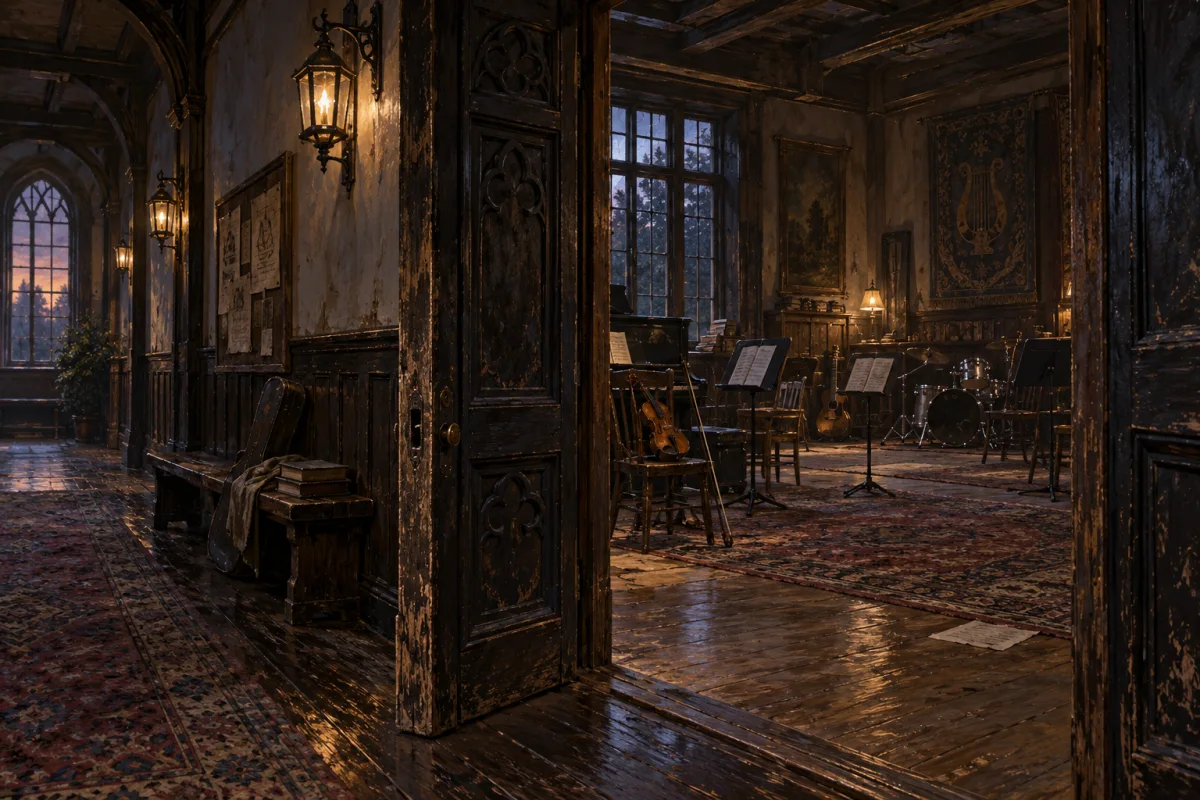
The Resonance Hall sits slightly apart from the main thoroughfare, an older building with blackened wooden features and a sign standing quietly out front. Lana approaches, knocks, and waits. No answer. After a moment, she opens the door herself and steps into a worn, dim hallway. The floor is scuffed, the walls aged, clearly less maintained than the rest of campus. From somewhere deeper within, faint musical notes drift outward—discordant, layered, messy.
Clutching her violin and bow, Lana quickens her pace. The sound grows louder, resolving into a full cacophony: violins in clashing keys, guitars doing their own thing, drums competing for rhythm. Everyone is playing, no one together. Lana hopes desperately that this is tuning and not an actual piece.
Aurelia stands at the center, scrolling through sheet music, preparing. Lana walks straight up to her, ignoring everyone else, and taps her lightly on the shoulder.
“Hello. Good evening.”
Aurelia turns, smiling brightly. “I am very good. I am very excellent. Please, take a seat. You and three others will play your first performing piece so we can see where to place you.”
Lana chooses carefully, sitting in the inner ring, as close to the first violin position as possible—close enough to signal that she understands how orchestras work, even if the seat itself is taken. The first violinist beside her introduces himself. “Welcome. Nice to meet you.”
“Good evening. My name is Lana Rimov.”
“I’m Alix,” he says, clearly excited. He’s a higher-year student, Prismari colors evident, friendly and curious. He admits there are high expectations here, and Lana answers honestly, mentioning she was told she might be a third or fourth violinist.
“We’ll see,” Alix says, smiling.
More musicians filter in. The noise continues—tuning, riffs, echoes bouncing off the dome. Lana notices the variety of instruments: strange flutes, hurdy-gurdies whining, bagpipes blaring, sounds she privately hopes will be pushed far to the back of the orchestra. One of the new arrivals in a first-year grey outfit carries no instrument at all, which draws her attention. There is only one other violinist among the new group who feels like potential competition.
The pressure Lana feels isn’t rivalry—it’s obligation. She needs this. Her scholarship depends on it.
Eventually, a sharp tap cuts through the noise. Silence follows.
“Attention, everyone,” Aurelia calls. “We have some new volunteers for the orchestra. They’re here to show us what they can do. From Arkevius and beyond—across the multiverse.”
She asks who wants to go first. Lana offers, but Aurelia gestures to someone else—the instrumentless performer. He steps into the center, drives a thin iron pin into the wooden floor, and as the lights dim, he seems to glow with his own confidence. Lightning arcs from his hands, producing an eerie, theremin-like sound as he moves.
To Lana’s trained ear, it’s awful. The pitch slips constantly, vibrato uneven, notes sliding under and over where they should be. Artistic, perhaps—but sloppy. The rest of the orchestra seems to agree, exchanging uncertain looks. The performer, oblivious, dances through his finale and ends breathless, arms spread.
There’s hesitant clapping.
“Thank you, thank you,” he says proudly. “I’m a natural performer.”
Aurelia only says, “That was… something. We’ll work with it.”
Lana studies her face. She seems serious.
Another audition follows—a percussionist, competent but unremarkable. Then Aurelia turns to Lana.
“What have you prepared?”
“A violin piece,” Lana says. She explains its origins: learned from her mentor in the north during the Giant’s War, a song of hope laced with cynicism, deeply personal.
“I’ll take the lead,” she adds. “If anyone feels it, they can join.”
She raises her violin and begins.
The piece starts light, folkloric, a melody that eases her into tune. Then, as the chorus arrives, Lana forgets the room entirely. Emotion overtakes her. Light spills from her eyes, the air swirling gently around her as magic bleeds through feeling she hadn’t expected to surface. For the first time, it’s clear she isn’t entirely what she appears to be.
The orchestra listens. A few join with cautious flourishes—bells, subtle harmonies—but many hold back, choosing instead to observe her technique, her bow control, her vibrato, the way she shapes emotion into sound.
When the final note fades, the applause is louder than any before it.
Lana had been terrified it wouldn’t land. It does.
Aurelia smirks. “I can work with that.”
Ruben sets off to do a bit of research. He has seen flyers around campus advertising Dragon Chess. With some effort, he tracks the flyers back toward the Archway Commons. South of the teleportation arrival point, near the Firejolt Café but slightly beyond it, he notices a building he would not have found easily without looking for it specifically. The sign reads: The Sanctum Game Hall. The name alone feels promising.
Ruben opens the door and steps inside. The venue is relatively small, packed with tables—around twenty of them—each occupied by students deep in games. The space is lively and vibrant, full of conversation and laughter. Cards slap against tabletops, pieces are moved, dice are rolled. But despite all of that, Ruben quickly realizes that no one here is playing Dragon Chess. Not a single board matches what he is looking for. There are many faces, many games, but none immediately familiar—until one is. Ruben recognizes one of the very first people he saw upon arriving at Strixhaven: Miss Galia. She sits at a table in simple student robes, less formal than before, playing a war-themed tabletop game he does not recognize. She does not seem intensely focused; instead, she looks relaxed, enjoying herself, chatting easily with the others at the table.
Ruben hangs back, standing a few meters away, careful not to intrude. He waits, watching the game, gauging whether it is close to ending. The players—a dwarf and a halfling among them—are clearly having a good time, sipping water and laughing. Miss Galia chats warmly with them, fully at ease.
When she finally looks up and notices him, Ruben speaks.
“Hello. This looks like an interesting game.”
“I met you on the first day,” Ruben says. “You’re Miss Galia, right?”
“I am,” she replies. “I guide the students.”
“I’m Ruben,” he says, then adds, getting to the point, “I’m actually here to find the Dragon Chess community. Do you know where I can find that?”
She looks a little disappointed. “Oh no. Ruben, do you enjoy games?”
“Yes.”
She gestures around them, to the laughter and easy conversation. She suggests that the board game club might suit him better—that Dragon Chess is too serious, too rule-heavy. Here, people are just having fun, playing simpler games without drowning in complexity.
Ruben listens politely but shakes his head. “I might find you later, but right now I’m looking for the Dragon Chess club. Do you know where I can find them?”
She nods. “The Dragon Chess players share this space with the club that is currently occupying the tables, but they are not gathering today. They meet every other day, with some scheduling oddities—every second day, sometimes on the last day of a ten-day cycle. There is another shared room nearby that they sometimes use.”
The group at the table seems welcoming, though, and Miss Galia invites Ruben to sit and play with them in the meantime.
The game turns out to be extremely simple. Ruben understands it quickly—too quickly. As he plays, he cannot help but feel that his intellect is being wasted. The game is almost entirely luck-based, with no real tactical depth. Still, it is social, and the others are enjoying themselves. Ruben plays a few rounds, making conversation, being polite.
As they talk, the subject drifts to the events in the Biblioplex earlier that day. Someone wonders aloud what the Strixhaven Star will write about it.
Ruben admits, “We were there.”
That sparks immediate curiosity. What happened? Was it a performance? Live action roleplay?
Ruben explains that it turned out to be a mimic. His dormmates destroyed it, helped the injured student, and called for a professor. No one was killed—everyone is safe.
The conversation shifts. Someone points out that the first rule of adventuring is to investigate what happened afterward. Did anyone inspect the remains? The chest did not vaporize. Pieces must have been left behind.
Ruben frowns. “What’s interesting about an exploded mimic?”
He is told, gently but firmly, that strange things do not just happen. This is not the first incident. A few months ago, there was another creature—possibly a bullywug—that appeared on campus. Monsters do not simply walk into Strixhaven. There are walls. Guards. Protections. Portals are warded.
“So,” Ruben asks slowly, “do you think someone let them in?”
That idea lingers uncomfortably.
Eventually, Ruben excuses himself. He has studying to do. Tomorrow is a study day—it is the weekend, after all—and Sunday is a social day. He mentions that he plans to attend the Dragon Chess club when they meet again. Not everyone approves, but Ruben simply smiles. “I think there are games for everyone.”
Before leaving, he introduces himself properly to one of the players. The dwarf gives his name as Rex.
Ruben heads to the Biblioplex, because Rex has intrigued him with the knowledge of investigating. Inside, everything has been cleaned. Tables are back in place. The chaos from earlier is gone—almost. As Ruben walks along the cabinets near where the stage once stood, something catches his eye. On the side of a finely finished oak cabinet, there is a small black mark. It stands out against the pristine wood.
He pauses. He was not expecting to find anything.
Ruben runs through possibilities in his mind. Illusion? Residual magic? Necrotic energy? He approaches carefully, extending a mage hand toward it, then stops himself, choosing caution.
He studies it more closely. It does not feel like unstable magic. When he finally touches it, he realizes it is not blood. The substance is semi-fluid, slightly sticky, a bit oily. Strange. Unfamiliar. It clings to the wood, forming small droplets that can be spread if disturbed.
Ruben retrieves a napkin and carefully collects some of the substance, thinking that Kroak might know more about it.
With that done, he settles in deeper within the Biblioplex, surrounded by books and quiet. He studies late into the night—he is a night owl, after all.
Kroak is on their way investigating, intent on gathering herbs, and more specifically on finding soot salt geodes- crystallized formations, the sort of thing you might find in caves or walking rock formations, maybe near a natural wall.. They are convinced there is a kind of place where such things must exist. This is a magical campus, after all, and in Kroak’s mind that means common potion ingredients should be easy enough to find.
It becomes clear that the central campus has no caves at all. However, Kroak knows—because they were told during the introduction—that old rock formations and excavation sites are part of the Lorehold campus. There is a shuttle that runs between campuses, taking about twenty to thirty minutes. Kroak immediately latches onto the idea. Lorehold it is.
Kroak heads to the edge of campus, where the shuttle waits. This is no ordinary bus. Floating there is a crystalline structure, half-connected pieces forming something like an elongated open chariot. Fractal, triangular elements interlock to create seats and edges, and pulses of energy ripple through it at intervals. The magic feels familiar, not unlike what Kroak has seen in the Hall of Oracles, though more focused. Two people are already seated inside, older students in Lorehold attire, quietly reading.
Kroak surveys the many empty seats and chooses one a couple of places away—not too close, not inviting conversation. They sit, keep to themselves, and wait. After about fifteen minutes, the structure hums to life. Power surges through it, and it lifts, accelerating smoothly along a long invisible pathway. There is a buzzing sound beneath and around them. Wind brushes past, yet Kroak doesn’t feel the movement, only the increasing speed. The green campus blurs, walls falling away as the shuttle races outward into a more barren, desert-like landscape. The sun has already set; evening has deepened into cold. By the time the shuttle slows, everything feels markedly chillier.
Lorehold rises into view—a massive crevice carved into the earth, illuminated by moonlight and the glow of countless buildings embedded in the rock. A vast road stretches across the gap. The scale of it all is overwhelming. The crevice is as wide as the central campus itself, an enormous hole plunging hundreds of feet down into darkness. Kroak watches the other students disembark and descend a set of narrow stone stairs with no railings, sheer drops yawning on either side.
They pause, looking around. “Oh yeah,” Kroak mutters to themself. “I’m gonna need some directions.”
Spotting the two Lorehold students from the shuttle walking away, Kroak follows, calling out, “Excuse me—hello!” The stairs down are unsettling, barely wide enough, and Kroak instinctively slows, although they have wings.
Catching up, Kroak tries to get both students’ attention at once. A dwarf and a human turn to look at them. Kroak introduces themself quickly. “Hi. I was hoping maybe you could give me some directions. I’m looking for a place to mine some geodes.”
“There’s plenty of places to do that,” the human says. The dwarf gestures casually behind them, toward the rock face, where Kroak can now see multiple caves and excavation sites—some sealed, some open. When Kroak specifies, “Soot salt geodes,” the words hang there for a moment. The human admits they’ve never seen such a thing, suggesting they might be in water caves—very deep ones. The dwarf nods slowly. “Soothed salt, yes. It is all the way on the bottom. But be warned. There are monsters in the deep.”
“What kind of monsters?” Kroak asks.
“Things older than time,” comes the ominous reply.
Kroak asks if it’s safe. The answer is blunt. “It is not safe. Not for a first year.”
“Maybe you come with me?” Kroak suggests hopefully.
The response is immediate refusal. The dwarf shakes their head. They have studying to do. Besides, the deeper you go, the more dangerous it gets. One of them looks Kroak over and adds, not unkindly but not gently either, that this is a desert. Water caves are deep, and there isn’t much water here. Everyone knows where water is in a desert—it’s at the deepest level—but they can’t recommend going there.
Kroak presses on, asking how long it would take to reach the bottom.
“Half an hour, if you climb the stairs,” they are told, followed again by a recommendation not to go.
“All right, all right. That’s not too far,” Kroak says, nodding. “Thanks.”
The two students walk off, shaking their heads. “What the fuck,” one mutters.
Left alone, Kroak exhales. They decide to explore one of the upper excavation sites instead—somewhere safer, somewhere they can look around without risking their life. The knowledge that the deeper caves are only half an hour away sticks with them, though. Maybe later. Maybe with help. “I can probably force Ruben to come with me,” Kroak thinks aloud.
For now, Kroak decides, it’s best to come back during the day, when it’s safer.
They wander Lorehold for a while, exploring. The campus is alive even in the evening. Arches span between caves, buildings cling to the sides of mountains, some hanging beneath overhanging stone. Students walk, study, live their lives among the rock and light. It feels ancient and vibrant all at once.
Kroak is glad for their wings. They fly, climb along undersides of walls, reach places that are harder to access. They explore, observe, and take note of what can be harvested here later.
Daiki works his shift at the Firejolt Café. There aren’t that many people playing games tonight. He knows how it usually goes: every other day the café fills up when students come to play, especially when the Dragonchess club is involved. Tonight, though, it’s calmer. Some people study, some talk quietly, others enjoy sweets and the general warmth of the café. It’s a nice place to be, people having a good time, being served, occasionally getting sweets tossed their way.
Daiki works for hours without doing anything special, except the thing that matters most to him. He watches people closely. It’s important to him that everyone is happy. If he notices even one student looking dissatisfied, he steps in immediately. “Oh, you’re not looking too happy—can I help you, make you feel better?” He adjusts, improves, fixes whatever can be fixed. Because of that, he becomes popular quickly. People relax around him. They’re happy he’s there, happy he helps.
As the night progresses, it gets busier. This is normal. It happens a lot. Around this time, Mina comes in.
“Hello, Mina,” Daiki says.
Much to his surprise, she looks genuinely elated to see him. She points at him, smiling broadly. “Great to see you.”
“Great to see you too—what?” Daiki blinks, a little confused by her excitement.
“What happened today?” she asks taking out her notebook.
“What happened today? Oh—you mean at the play?”
“Yes, at the play. What happened?”
“Oh, it was amazing. It was just the greatest. Ever. What do you want to know?”
“I heard there was an attack. People were hurt. Do you have a story for me, for the Strixhaven Star?”
“Oh yes, yes, yes. They almost bit off their hand, or arm, or maybe their whole upper body—I don’t know. But we—we were the heroes. We saved them.”
“Who’s we?”
“Me and my dormmates.”
Mina starts writing immediately. “Dormmates… yes. Which dorm were you in again?”
“Which dorm… I believe we were dorm 72A.”
“Who are your dormmates?”
Daiki thinks. “There is this woman with glasses and— yes! Her name is Lana. And we have the owlin, which is—I don’t know, he used to have a blue robe. Not anymore, now we have uniforms. How do you describe an owlin? He looks younger. His name is Ruben. And then we have Kroak, a fairly strong but also…” He trails off.
“Oh yes! You have to write about potions and prophecies,” Daiki says earnestly.
“Potions and prophecies,” Lana echoes.
“Because we heroes, we save our people with potions and prophecies.”
“What prophecy did you save them with?” Mina asks. “No—no—the potion?”
“We saved them with—”
“But there was also a prophecy, you said.”
“Of course there was a great prophecy. The monster that will attack the—”
“It was known beforehand?” Mina sounds amazed. “Why was there no warning made?”
“I don’t know. But we saved them by calling the teacher.”
“Calling the teacher? Which teacher?”
“Sharpeak—no, no, no, wait,” Daiki interrupts, waving his hands. “I have to be clear. We saved them, and then we got a teacher. But not everyone was aware. It was not part of the play, so we were just playing along.”
Mina looks delighted. This is going to be an amazing story. Super good.
“You want me to bring the others here so you can ask them questions?” Daiki asks.
“Yes, yes.”
“Well, they are all working now. Someone is at the orchestra. We can meet tomorrow. Oh yes, tomorrow. We thought we were studying tomorrow.”
“I’ll make the first draft tonight,” Mina says. “We need to post the first story tomorrow. But I can see a second story the next day.”
“Yeah, yeah,” Daiki says, excited. “Like, you know, in-depth. The story of the story. Maybe the story behind the story.”
“Yes. Who is who.”
“Or is that too much of a joke to an owl?” Daiki wonders aloud. “I don’t know.”
“I don’t see the problem,” Mina replies. “Thank you. That’s amazing.”
“Yeah, yeah, yeah—but I see someone over there I need to serve.”
“Okay.”
“I’ll be right back.” Daiki goes to help someone, then returns.
Mina keeps writing.
“Oh, don’t forget the special effects we used,” Daiki adds.
She notes that too, trying to be poetic. Mesmerizing, without mentioning blood.
“There was a lot of blood,” Daiki says anyway.
Mina writes carefully, making it sound beautiful without saying the word.
Daiki continues, more serious now. There’s a clue. There are a lot of chests, but one of them was a mimic. Why, if there are more chests? Maybe there’s an infestation. The teacher said they were very hard to distinguish from normal objects. Sometimes monsters come onto campus. It’s dangerous.
“But no one died,” Daiki says firmly.
Mina looks relieved. She’s happy they were there to save people—and to tell her the story. This feels like a breakthrough.
“I thought you would like it,” Daiki says. “This is amazing. Do you remember the story of the missing cheesecake?”
“I do not.”
“I thought you wrote about it.”
“I may have eaten it,” she admits.
“Maybe I just dreamed about it,” Daiki says. “I dream a lot about this place.”
It’s late. They agree to meet again tomorrow afternoon, during Daiki’s shift. He’ll bring Lana, Ruben, and Kroak. Mina thanks him again for all the information.
Daiki goes back to serving people, the rest of the evening is uneventful. More people come and go. Everything is normal. Eventually, the Firejolt Café dies down.
Daiki stays busy enough that he doesn’t really notice people talking about the play, though sometimes someone looks at him a bit too long and then looks away when he approaches. He hears fragments of conversation, hard to piece together. His head is already on promotion. This could be good. He thinks his friends will like this.
Around midnight, things wind down completely. Daiki finishes his shift and heads back toward the dorm, the night settling around campus as the café lights dim behind him.
After the auditions, sheet music is handed out in small booklets, passed from hand to hand. Aurelia distributes them calmly, then looks at Lana, then at the violin section.
“I think you got what it takes to be third violin” Aurelia says. She studies Lana for a moment longer. “And now you have to prove that I’m right on that. If you can do better, be better. Work your way up. Study hard.”
She reminds her that an orchestra is not about any one person. All the parts make the whole. Lana nods immediately. “I totally agree.”
Aurelia seems pleased. “I think you’ll make an excellent supporting role in the third violin.”
“Thank you so much,” Lana says.
Everyone begins taking their places. Most of the orchestra looks content, but Lana notices two people who clearly are not. One girl in the violin section looks openly displeased. She stands, shifts one chair over, and takes the seat beside Lana instead.
Lana calmly takes her place next to her. She turns, keeping her voice neutral. “Hello. I’m Lana. I see you’re not very happy. Have I done something to offend you?”
The girl exhales sharply. She explains that she worked hard for a year, hoping to move up to second violin, only to be pushed down instead. Lana listens without interrupting.
“I’ve played in other orchestras,” Lana says gently. “I can imagine how awful that feels. I’m sorry.”
The girl admits she needs time. She had hoped this year would finally be different. Lana asks her name.
“Ari.”
“Well, Ari,” Lana says, “I didn’t even know until today that I was here on a scholarship. I had to prove myself just to be allowed into this orchestra. For me, this was a surprise. I can imagine for you it’s a very negative one. But let’s make a good season of this. We’re an orchestra together. I hope we can join forces.”
Ari nods, clearly fighting tears, anger just beneath the surface. Lana gives her space. “If you need someone to talk to, let me know. Let’s play.”
The sheet music for the first pieces is handed out, and the orchestra begins. Aurelia steps onto the stage, tapping lightly to draw them together. They tune as one, strings wavering at first, then settling into shared pitch. When they start playing in earnest, the familiarity of the seasoned musicians is obvious. The percussion enters confidently. Lana can play the notes, but she is sight-reading at speed, struggling to translate the sheet music into a living piece of art. Her bow lags behind the others. Where the rest of the violinists relax into known bow lengths, Lana rushes, chasing the music instead of shaping it. The sound is there, but the music she wants to make isn’t.
Practice stretches on for hours. Aurelia stops them often—tap, tap, tap—cutting out bars, calling out mistakes, sometimes singling someone out, sometimes the thermin-player who keeps drifting. “Keep to the notes,” she snaps at one point. It is an entirely new dynamic, and Lana feels it. Four hours pass like this, then more. When it ends, Aurelia reminds them that while they practice together three days a week, the rest of the time they are expected to practice alone. She looks directly at those with less orchestral experience.
Lana greets people as she leaves, hands out the treats Daiki gave her to distribute, and suggests the violin section practice together. There are six violins in total. They agree to keep in touch. It is late by the time she walks back toward the dorm, passing the Firejolt Café along her usual route. Daiki is still working.
“Did they like the sweets?” he asks.
“They really liked it,” she repeats.
Daiki smiles but has to return to work. “I’ll be back at the dorm after my shift. I have something great to tell you.”
“That’s great,” Lana says. “I became third violinist out of six.”
“So third violin means you’re not the best, but also not second best?”
“Exactly. But I’m also not the worst.” She hesitates. “There was another girl. She’s been trying for a year and is now demoted. I felt bad for her.”
Daiki nods. “If you belong there, it’s fine. I hope you gave her extra sweets.”
“No,” Lana says flatly. “Why would I do that?”
They part for the night.
Around midnight, everyone slowly gathers back in the dorm. Most are already asleep—Seraphine, Nimri, Edrin. Pell is still awake at the table, studying. Kroak arrives late, covered head to toe in yellow dust and sand.
Lana stares. “Why are you covered in sand?”
“I went to Lorehold campus,” Kroak says casually. They explain it was dusty and cold, much bigger than expected. Lana presses, suspicious, but Kroak admits they were scouting for ingredients.
Daiki quietly shares his news. “Everyone’s talking about us. The story’s getting published in the Strixhaven Star.”
“The mimic?” Lana asks.
“Yes. The play. The whole thing.”
“It wasn’t a play,” Lana says sharply. “I saw the blood drain from that student. It was an attack.”
Ruben nods. He explains he investigated afterwards and produces a napkin with black, oily splatters from near the cabinet. Kroak examines it, sniffing. It smells foul, unnatural—nothing they recognize.
Ruben adds that professors insisted monsters aren’t supposed to be on campus, yet rumors suggest otherwise. A bullywug recently entered the grounds without public explanation. A pattern, perhaps.
Daiki mentions that tomorrow afternoon, during his shift, a colleague named Mina wants to interview them about the story behind the story.
Conversation drifts. Kroak suggests traveling together someday—other campuses, Lorehold included—but admits some places aren’t safe alone. Lana agrees they should think carefully.
Eventually, attention turns back to Pell. Daiki floats over, peering at his work. It’s full of formulas, letters, symbols—nothing familiar. Pell looks exhausted but wired, eyes bright.
“What did you learn today?” Daiki asks.
“A lot,” Pell says. “This was a perfect day. I learned I really like coffee.” He talks about artifacts, about boundless coffee, about studying all night. Ruben joins him, and the two begin studying together. They jointly go over the content of Basic Magical Auras. Pell reads two books at once, recalling passages almost perfectly, answering all questions Ruben can think of with uncanny speed.
Lana watches, worried but silent. Eventually, she excuses herself, careful not to wake Edrin, and goes to bed. Ruben and Pell continue flipping pages at their own pace, nibbling from sweet treats Daiki brought at the end of his shift. A full day of study time waits ahead!