Live session 16 — 3 May 2026
Daiki throws his arms wide. “The heroes of Strixhaven have returned!”
Lana immediately groans.
The crowd is massive. The entrances into the center of the commons are nearly blocked by students pressing inward. Nymri stands atop the fountain in the middle, using it as a makeshift platform.
Before they join the crowd, Lana quickly gathers everyone together.
“Reveal anything of what we saw and we’re in trouble,” she says. “We need to first go to the right authorities. We don’t need to spread this around. Keep your mouth shut about the bayou.”
Daiki blinks. “What did you say?”
“Agree,” Ruben says.
“Can’t we tell everyone about our adventure?” Daiki asks.
“Not yet. This is a very delicate matter.”
“We can share that we missed the last trip back, right?” Ruben suggests.
Lana nods. “We need an explanation. We went to gather ingredients for a professor and missed the last shuttle. That’s all.”
Kroak tilts their head. “You went to gather ingredients for the professor, right?”
“Sure,” Ruben agrees.
“We missed the shuttle,” Lana continues.
“Do we need to announce that we’re not dead?” Daiki asks.
“Let us do the talking, please, Daiki.”
“After class,” Lana says, steering the conversation back on track. “We meet up, discuss the ingredients, discuss the information. Classes come first.”
“So I’ll just go to Nymri,” Daiki says.
Daiki launches himself into the air and heads toward the fountain.
Ruben follows. Meanwhile Lana has no choice but to push through the crowd on foot.
“Excuse me, excuse me. Lana Rimov coming through.”
As Daiki approaches Nymri, voices rise around him.
“We need answers!”
“We want answers!”
“No more disappearing students!”
Lana finally loses patience.
If the crowd refuses to calm down, then she will make them calm down.
Stepping into the middle of the gathering, she raises her voice.
“The four students that are missing have returned! Daiki, Kroak, Ruben, and myself, Lana! There is no need for—”
The announcement cuts through the crowd instantly.
Nymri spots them immediately. Relief floods her face as she rushes over and throws her arms around them. She is genuinely overjoyed to see them alive.
“You guys are always getting in trouble,” she says.
“Well,” Ruben admits, “that’s quite true.”
He explains that they were gathering herbs for Professor Lang and missed the last coach back. They had no way to contact anyone and apologize for worrying everyone.
Lana, meanwhile, looks around at the sea of people. Then, suddenly, the crowd falls silent.
At first Lana thinks her announcement finally worked. But people are no longer looking at her. They are looking past her.
The fluttering of wings carries a presence that radiates authority. Without fanfare, the Dean of Silverquill arrives and lands almost silently beside them.
Students who moments ago were shouting now whisper nervously. The silence spreads outward until the entire commons becomes still. Nobody dares speak.
Dean Thalonrook waits until every eye is on her. “There is a line from Aretta of Westphale, one of my favorite poets. She wrote it as a little girl after the second siege of her city. She was very afraid. She could not sleep. ‘Fear tells us the lamps are worth lighting.’ Think about that for a moment.”
The crowd listens. Ruben associates the past events more with “Lambs are ready for slaughter”, yet does not dare to share his thoughts.
“Fear is gripping our campus. It grips me as well. Anyone who tells you otherwise is mistaken. Danger came to this campus at the Rose Stage, at Firejolt Café, and most recently…” She gestures toward the four students. “Down in Sedgemoor.”
The commons remains utterly silent.
Ruben, moved by the speech, starts clapping far too early.
Nobody joins him.
Realizing his mistake, he immediately stops and blushes.
The Dean of Perfection continues as though nothing happened.
“This morning they stand before you. Proverbial heroes.”
Lana’s thoughts instantly leap to Ruben.
How does she know?
None of them have ever met her.
The Dean beckons the four students forward. Reluctantly, Lana joins the others atop the fountain platform. Daiki strikes an enthusiastic pose. Ruben simply straightens himself and tries to look presentable.
The applause that follows is confused but genuine.
The Dean tells the story of their journey. How they left while everyone else remained behind. How they traveled into danger. How they returned.
“Some of you call it recklessness. I am going to keep calling it courage.”
She speaks about curiosity, courage, and the willingness to act when others hesitate.
“The lamp in these students still burns.”
She addresses the protesters directly.
“Those of you who came purely to protest can keep questioning this institution. That is one of the lessons we are here to provide. One of the things we wish to foster.”
Her promises are careful. She refuses to claim nothing bad will ever happen again. Instead she promises that the campus will be safe for the coming week and that every precaution is being taken.
Then she announces that classes are canceled for the day.
The campus will have a day of reflection.
The café will remain open.
“The lamp will be lit.”
She points toward the four students.
“Look at these four. And look at yourself. In the garden of the mind we grow at Strixhaven.”
When she finishes, the crowd applauds.
This time Ruben joins in at the appropriate moment.
Lana studies the speech carefully. Every word is expertly chosen. Every pause is deliberate. Nothing she says is technically false, yet Lana cannot shake the feeling that the message is being shaped and molded into exactly what the Dean wants people to hear.
She can appreciate the skill. She still dislikes it.
After the speech, Ruben politely asks whether Professor Talos knows that Archeomancy classes have been canceled as well.
The Dean smiles. “For you, there will be a debrief in the Biblioplex. We need to discuss what happened. I have been watching along.”
That statement catches everyone’s attention.
“Watching along?” Kroak asks.
“As Dean, I must keep my eyes on important events.”
Ruben immediately asks whether she has been using divination magic to observe them.
The Dean explains that several gifted divination casters assist her. More importantly, the Strixhaven pendants issued to students help locate them if they go missing.
“They are not meant for spying,” she says. “They help us find students.”
“That’s convenient,” Ruben replies.
The conversation turns briefly toward divination. Ruben expresses an interest in studying it further. The Dean praises his developing abilities and remarks that Strixhaven has provided the circumstances necessary for him to unlock his potential.
Eventually she prepares to leave.
Before departing, she quotes another passage from Aretta of Westphale, speaking of orchards, strange fruit, and growth. Once the Dean leaves, the group finally exhales.
“This started quite differently than expected,” Ruben says. “This is quite the attention. I’m not sure we deserve it.”
“It’s okay,” Daiki says. “We all deserve things. Just enjoy it.”
They begin discussing their next steps. Ruben suggests cleaning up at the dorm first before meeting the professors. Daiki immediately uses prestidigitation on himself.
Then Ruben turns to Lana. “Well, there goes your stealthy approach, announcing yourself like that.”
Daiki shakes his head. “No. I actually liked how Lana acted. She sounded like a leader. You want to become a leader, right?”
Lana does not respond.
Daiki keeps going. “Maybe I would have added more fireworks and glitter, but it was really nice. We can’t be called the heroes of Strixhaven forever. We need a name for our group.”
Lana cuts the discussion short.
“Can we please plan today?”
Everyone agrees they should go meet the professors.
On the way, they stop at Firejolt Café for breakfast.
Daiki immediately attempts to negotiate.
“We have returned as heroes of Strixhaven. Surely we deserve a special welcome-back meal?”
The café staff are delighted to see him alive and happily prepare a special breakfast spread. Sweet rolls, pastries, and magical treats soon cover the table.
Lana takes a normal savory roll instead.
Ruben contributes a silver piece and happily enjoys the meal.
One pastry is made with what the staff call “the butter of bravery,” granting courage in moments of fear.
Another provides a vague glimpse of the future through a single yes-or-no omen.
Daiki receives a magical muffin that helps him recall something he has heard with remarkable accuracy.
“A muffin of minor memory,” he announces proudly.
The group enjoys the breakfast together before continuing toward the Biblioplex.
As they walk, they continue debating possible team names.
Eventually they arrive at the Biblioplex.
A small meeting room awaits them on the north side of the building.
Inside sit Professor Lang, Professor Talos, and Professor Vantrax.
The professors have clearly been waiting.
“Good morning, professors,” Ruben says.
Daiki waves cheerfully.
“Here we are.”
Lana gets straight to the point.
“Do you already know what happened? And where do we come in?”
Professor Talos immediately shuts down the question.
“You will tell us the story as you experienced it. We will ask follow-up questions.”
Lana points out that the Dean already seems to know quite a bit.
“What the Dean knows is not relevant,” Talos replies. “We need the truth. We need your account of reality.”
Daiki volunteers to go first.
Lana suggests a single combined account instead of four separate retellings.
Talos agrees.
“Please add anything you think is relevant.”
Ruben offers to supplement the story with illusions so everyone can see what happened visually.
Lana begins at the beginning.
She recounts Sally’s information, the investigation, the assignment, and the journey into Sedgemoor. She describes the boat ride, the dangerous turns, the near collision, and their eventual arrival at the hidden location.
She continues describing the cabins, the Worgs, and the voices demanding a dark magic item. She explains the fight that followed.
Then comes the underwater section.
Ruben and Kroak diving below, the scorpion, the strange pool, blue tendrils, the runes and the chamber beneath. Ruben supplements the account with vivid magical illusions, recreating the symbols and patterns they discovered.
Kroak attempts to reproduce every rune they recorded.
Then they bring out the moss-covered book. The pages are filled with sketches and illustrations.
Frogs, boats, everything. Everything they experienced.
Throughout the tale, Professor Talos sits with his arms crossed, watching the group with a distinctly judgmental expression. Professor Vantrax nods along whenever specific techniques or methods are mentioned, clearly interested in how they approached their problems. Professor Lange listens carefully, focusing on how the creatures behaved, how events unfolded, and asking clarifying questions whenever needed.
“The big conclusion,” Daiki says, “was Lana swimming in and everything evaporated because she had this holy water and then she put it out and we saved the world.”
“Sort of,” Lana replies.
As the discussion continues, Lana explains that Ruben investigated above the water while the others handled the situation below. Conversation turns to the strange waterlogged book.
Ruben elaborates. “Interestingly, it showed us the drawing of the frog event at the Bozen Tavern, but it also gave a reference to an occurrence that will pass in Biblioplex. That means maybe something is up, or it’s the event we’re talking about today. We don’t know what the triggering events were. And annoyingly, the signatures or names have been hidden by fungi or moss, and we couldn’t figure them out.”
When asked about his Archaeolomancy studies, Ruben explains that he has only read the first chapters so far. He describes how he tried to investigate the stories behind objects and the histories attached to them. Though he speaks confidently, he knows there is still much left to learn and finds himself looking forward to future lessons.
Lana finishes recounting their journey, describing how they collected the flower from the snake tree, the cactus from the quicksand, and the reeds from the bayou before finally making their way home and resting after the ordeal.
Kroak adds practical details about the harvesting process, how much of each ingredient was available, and the success rates involved.
“Well, thank you, Lana,” Ruben says. “It was quite complete.”
“Thank you for assisting,” Lana replies.
Daiki, however, still has something on his mind.
“Well, Professor, you wanted everything that’s relevant, right? I’ve been thinking on the long, long, long way back home and… what if I forgot one thing?”
“We forgot one thing,” Lana says. “Ruben stayed behind. We heard very big footsteps and rumbling, so we thought we needed to get out because we almost died. He stayed behind very bravely.”
“It was a blue Slaad,” Ruben continues. “And surprisingly, it felt more intelligent than the Slaadi we learned about. It seemed to have more of an investigative purpose. I tried to determine if it was a disguise, but I think it was some kind of smarter blue Slaad.”
“Very interesting,” one of the professors remarks. “They do not normally go around that part of the bayou.”
“Well, this one did,” Ruben replies.
The observation causes thoughtful silence before Daiki suddenly remembers his own theory.
“Oh! I remember what I wanted to say. The whole thing was underwater, right? And we can stay underwater for a while, but I don’t think Kroak was there because we were with them the whole time. So who could have done this? What if that bullywug that disappeared long, long ago was there?”
The room falls silent.
Ruben eventually breaks it. “I think we ended the story and now we’re into speculative mode, but I think it’s great to share.”
“He wanted everything relevant,” Daiki insists.
“How did you come by the conclusion that it’s been a bullywug?” comes the question.
“Well… it’s underwater.”
“There are spells,” Ruben points out.
“And items,” Lana adds.
“Potions,” Kroak says.
Daiki pauses. “I didn’t think that through.”
Still, he shrugs. “I don’t know. For me it makes sense. It disappeared, and maybe it’s in the—”
Before he can finish, attention returns to the mysterious book.
“Let me take a look at the book.”
As the professors inspect it, Lana begins replaying Ruben’s earlier observations in her head. Several events they encountered had been sketched in the book before they happened. The reference to Biblioplex suddenly feels much more ominous. She reaches out telepathically to Ruben.
Okay, being totally detailed and conclusive—the event in the Biblioplex is still going to take place, and we are now at the Biblioplex. What if everything goes wrong?
Ruben’s response is immediate.
“Well, I’m quite sure this will happen. I mean, this is what happens every time to us. So I’m expecting that, to be honest.”
From that moment on, Lana becomes noticeably more alert. She watches the room carefully, looking for anything out of place.
Meanwhile, Professor Talos reaches toward the book. Just before touching it, he hesitates and instead conjures a Mage Hand to retrieve it.
“We also used Mage Hand first, Professor, before touching it,” Ruben notes.
The book floats before him. Talos studies it carefully while Lana watches his reaction. She wonders if his hesitation means something more.
Eventually it becomes clear that it is not guilt that made him hesitate.
The book itself radiates a magical energy that none of the students noticed.
“There is some very powerful magic lying dormant over this,” Professor Vantrax says. He looks toward Ruben. “It is good that you handled it with care.”
Only Talos and Vantrax seem aware of the aura. Professor Lange remains occupied, still thinking about the strange Slaadi encounter.
The professors inspect the artifact in earnest. Talos flips through its pages, occasionally peering over his glasses at the group.
“This is a very dangerous artifact.”
“Why was it in the swamp?” Daiki asks.
“That is an excellent question,” Talos replies. “Why was it in the swamp? And your suspicion regarding a bullywug might be true.”
Daiki nearly chokes on his own surprise.
The professors continue examining the book. Then they direct the students’ attention to the moss growing across its cover.
Looking more carefully, they finally notice something they had missed before. The moss is not random. It follows a distinct shape. On one side are the impressions of three fingers. On the front is the outline of a hand.
“A bullywug hand,” Lana realizes.
There is a burst of excited disbelief.
The professors decide the artifact is too dangerous to leave unsecured. It is sealed inside a magically protected container and taken away for safekeeping.
“Excellent work,” Vantrax says. “Well done. It seems our proverbial heroes of Strixhaven have produced something meaningful.”
The teachers exchange looks that reveal their differing perspectives, but eventually one final question is posed.
“Is there anything else we should know, or can we conclude this investigation?”
Daiki raises a hand. “Well. It was very, very dangerous. And we produced something very useful. So…”
Lana immediately realizes where this is going. “Oh my god, he’s asking for payment.”
“A reward,” Daiki clarifies.
The professors exchange amused looks.
“Initiative is definitely rewarded,” one of them says.
“Professor, Dean Thalonbrook mentioned our endeavours were about nurturing the garden of the mind. What we tend together does not go out. It’s a poem that I can’t fully recite, but I’ll definitely look it up in the Biblioplex.” Ruben says.
The request for a reward is gently sidestepped. Makeup classes are scheduled for the following day to compensate for the time lost during the investigation.
“Thank you so much,” Lana says. “Thank you for receiving us. Thank you for letting us tell our story.”
“You’re very welcome,” comes the reply. “And please, going forward, keep out of trouble.”
“We cannot promise you that,” Lana says. “But we will try our very best.”
“I feel like trouble finds us and not we find trouble,” Daiki adds.
The professors seem unconvinced but wish them an enjoyable summer break nonetheless.
As the meeting concludes, Lana thanks each professor personally and offers handshakes. Talos briefly unfolds from his perpetually cross-armed posture long enough to return the gesture before immediately reverting to it.
After the others depart, Professor Lang remains behind.
“It was great to hear your story,” she says. “Sorry for putting you into so much danger, but it was the best way to get it done.”
“The gathering of the herbs was not the greatest danger,” Lana replies dryly.
Professor Lange smiles and presents them with a reward after all: a beautifully crafted Bag of Holding decorated with natural patterns and purple flowers, reflecting her Witherbloom roots.
“For your good gathering of the herbs,” she says. “These ingredients are expensive individually, but this should help you carry them.”
The group stares at the gift.
“A Bag of Holding?”
“To you as the heroes of Strixhaven.”
She even includes a small note with it. “Be filled with hopes and dreams—but rather ingredients.”
Kroak immediately begins unloading their existing storage. Bags, cauldrons, tools, and all manner of supplies start spilling out across the room.
The rest of the day passes more peacefully.
Lana writes letters to her parents and to Jorund, explaining recent events and discussing the oath she swore. Ruben spends time in the Biblioplex searching for the full poem referenced earlier by Dean Tullenbrook. After some searching, he finds a short piece by Auresa of Westfield:
“What the fire knew and the seeds knew and we did not.
Only in burning, smaller and stranger, bearing fruit we have not planted together, does not go out.”
The poem reflects on an orchard fire and the seeds that sprouted in its aftermath. Ruben finds himself pondering its meaning long after he finishes reading.
Kroak spends time reviewing alchemical recipes and the ingredients they gathered, while everyone else enjoys a rare chance to rest.
As evening settles over campus, attention turns to summer plans.
Sszethik announces that he is finally returning home and begins describing the warm, humid jungles where his family lives. He enthusiastically invites everyone to visit.
“You can meet my family,” he says. “And I can show you beautiful places I used to visit when I was young.”
The invitation sparks a lively conversation. Lana suggests a visit to her hometown as well, while Sszethik proposes five days in his homeland.
“I would love to see where you are from,” someone says.
The group quickly begins discussing schedules, gifts for families, and travel arrangements.
“Maybe we have to think about a gift for both of your families for hosting,” Ruben suggests.
Sszethik shrugs. “My parents live in the jungle. Rather simple. Bring something shiny.”
“And what do your parents like, Lana?” Daiki asks.
“My father is a cook and my mother runs the inn,” she says.
The conversation drifts from gifts to food, dragons, weather, and travel plans. They compare cold northern climates with warm southern jungles, joke about local cuisine, and eagerly imagine the adventures waiting for them once summer begins.
By the time the discussion winds down, excitement has replaced the tension of the investigation. The dangerous book has been secured, the mystery remains unsolved, and future journeys await.
Morning approaches.
A new day begins, and classes.
The group’s morning classes take them in different directions across Strixhaven.
Lana, accompanied by Nymri, heads to the Silverquill campus and enters the main lecture hall. The room is magnificent, a vast auditorium with tiered benches rising toward the back, decorated with feathers, ink motifs, and elegant Silverquill flourishes. The professor stands at the front, stone-faced, waiting in silence as students file in and take their seats. Lana and Nymri settle in the third row.
As the room fills, the professor lifts a hand. Ink swirls through the air and writes across a massive sheet behind him. Tiny ink-like creatures dart across the page, forming letters as though the words themselves are alive.
When the hall finally falls silent, the professor speaks.
“We’re going to start. I want everybody to pick a word. A word with meaning. A word to evoke a magical effect. If you are unable to do so, you will have already failed this class.”
Nymri looks completely baffled.
“What the fuck is up with this guy?” she tries to whisper, but no sound leaves her mouth. The professor has somehow silenced the room.
“Write down the word,” he continues. “Bring it to life. Be confident in this. The inklings will disobey you and you will write something different.”
Lana immediately loves it.
The first word that comes to her is devotion.
She lowers her pen and writes. The ink flows effortlessly, the D already stretching toward the E before she consciously forms it. Beside her, Nymri writes revelation and appears equally successful.
As sound slowly returns to the room, confusion erupts elsewhere. Students stare at their pages in horror as words transform into entirely different ones. Some attempt to start over, crumpling sheets and grabbing new paper, only to discover that the unwanted word appears again no matter what they do.
The professor watches the chaos without sympathy.
“I have found the first people that failed. You may try again next semester.”
The lesson continues in much the same fashion. Students are challenged repeatedly to manifest meaning through language and intent. Lana thrives in the environment. The class feels less like writing and more like performance, memory, and emotion woven together through magic. Nymri’s choice of revelation catches Lana’s attention as well, and she files it away for later thought.
Meanwhile, Ruben and Kroak make their way to the Lorehold campus for Archaeomancy. On the walk there, Ruben discusses preparations and readings with Kroak, summarizing chapters, divination concepts, historical techniques, and investigative methods. He notices again that despite how Kroak often behaves, they retain far more information than people tend to assume.
Their classroom is unlike any classroom Ruben has ever seen. Rather than desks and chairs, it resembles an antiquarian’s shop filled with statues, relics, artifacts, and curiosities. Students stand among the displays while Professor Talos waits for them.
Today, Talos seems much more at ease than during previous encounters. He remains stern, but here he is clearly in his element.
“Good morning, Professor Talos,” Ruben says.
“Good morning to you.”
Ruben immediately begins examining the room, positioning himself beside a statue and absorbing details from every artifact he can see.
“Some of you are already starting to look around. Excellent,” Talos says. “Can you see? What can you find? What can you uncover about artifacts?”
Ruben answers that he is using his senses.
“Please use your eyes,” Talos replies. “Not your nose. It is inappropriate to use your nose. We later will learn how to use our hands as well. Do not smell. Did you get that?”
Ruben cannot help finding the warning slightly amusing.
Talos begins questioning the class.
“What do you think is associated with archaeomancy?”
Ruben explains that objects themselves serve as primary sources of information. Rather than relying on stories told by others, archaeomancers seek truth directly from surviving artifacts.
“The actual object,” Talos agrees. “But how would the object give you that information?”
“All objects have spirits, right?” Ruben says. “And if we can get the right spirits to help us, then we can determine the actual meaning and purpose and history of that object.”
Talos counters that a detailed ownership ledger can often be just as valuable.
“What is that called, please?”
Ruben struggles for a moment before the answer suddenly comes to him.
“Provenance, Professor.”
“Very good.”
The professor nods approvingly.
“Because provenance is important for authenticity and ownership,” Ruben says. “Property value as well.”
“Exactly the terms we were discussing.”
The lesson continues through discussion. Ruben suggests that magic can help uncover information.
“It is not,” Talos replies, “magic can help us, but it can also harm us. For you, it is extremely important in archaeomancy.”
He writes a word across the board.
Restraint.
“When handling potentially dangerous artifacts, we should always be prepared for side effects and restrain ourselves from using them inappropriately.”
“It’s about controlling your impulses,” Ruben concludes.
“Indeed.”
Talos reveals five objects inside a protected glass display: a cracked teacup, part of a child’s toy, a red crystal shard, a sealed envelope, and another damaged relic.
“What do you tell me about these?”
Kroak immediately casts magical detection, only to discover that the display case itself blocks magical examination.
“Excellent,” Talos says. “The restraint, indeed.”
He points at the word on the board.
“What should we do? How can you find their lineage? How can you find out about their provenance?”
When Kroak struggles with one line of inquiry, Talos turns to Ruben.
“Take any object. Say something about any of these objects.”
“The red shard,” Ruben says.
“Excellent. What can you say about the red shard?”
“Well, if it’s a shard, it means it’s part of a larger whole.”
“How would you figure that out?”
Ruben refuses to touch it directly.
“Investigating it would require touching it, which can be dangerous. I think restraint is important here.”
“Excellent. How would you inspect it?”
“With a mage hand.”
Talos approves.
Ruben carefully lifts the shard from its protective field with his feathered Mage hand. Rotating it in the air, he studies the broken edges and concludes that it truly is a fragment of something larger, likely broken apart by physical force following the crystal’s natural structure.
Talos nods and points another student toward the cracked teacup. The student handles it carelessly. The moment it leaves the protective barrier, the cup shatters.
“This is excellent,” Talos says. “A live demonstration of why procedures exist.”
The rest of the class becomes an extended exercise in careful examination. Students move from artifact to artifact while Talos guides them through proper handling, observation, and historical reasoning. Ruben thoroughly enjoys it.
At the same time, Daiki attends History of Magic and Art at the Prismari campus.
The campus leaves him completely awestruck.
Everywhere he looks, artists create wonders. Fire, ice, lightning, paint, sculpture, music, and movement blend together into living performances. Great arches rise overhead, vibrant colors streak across the sky, and magical displays unfold in every direction.
Daiki feels immediately at home.
He darts from one spectacle to another like a hummingbird among flowers.
“This is amazing! Oh, this is even more amazing!”
At one point he creates a beautiful dragon of fire simply because he cannot resist joining in. Eventually he remembers he actually has a class to attend and rushes toward the lecture hall.
Inside, the room resembles a theater. A stage occupies the center while students gather around it. Daiki arrives among the last.
Then the lights dim. Curtains fall. The room erupts into performance.
The Dean of expression sweeps onto the stage amid dancing fire and brilliant light.
“Welcome, students, welcome!”
The crowd bursts into applause.
“Today we are going to paint. By making art now, tomorrow it becomes history.”
The logic makes perfect sense to Daiki.
The dean moves among the students, encouraging them.
“What do you feel? Paint it. I want to see your talent. I want to see it overflow onto the page.”
Daiki immediately begins painting a dragon. He recreates a memory from the Moonshade Isles: a red dragon soaring across the sky while a golden giraffe-like creature rises to challenge it above the sea. He intends the painting to depict history itself.
The dean glides elegantly across the room, examining students’ work before stopping beside Daiki.
“Oh, this is so beautiful. What feeling do you try to evoke?”
“A sense of danger coming,” Daiki says. “But the heroes are here to fight off danger, and we will all be safe.”
“Beautiful. You can make it bigger. You can make it bolder. You are one of the heroes.”
“Of course! I should paint more dragons! And my friends!”
He immediately adds them.
The dragons are magnificent. The figures representing his friends—and himself—look like simple stick figures by comparison.
“This is beautiful,” the dean says. “You’re doing very well. You’re making history right here.”
Later, the class shifts into an examination of historical art. A massive painting is unveiled before the students, and the dean passionately describes the emotions contained within every brushstroke. The lesson becomes as much performance as history, and Daiki loves every second of it, not recognizing the hand of the Dean in this art nor its creation just one day ago.
After lunch, the group reunites for Arcano-Botany on the Witherbloom campus.
The laboratory resembles a cross between a greenhouse and a research facility. Plants fill the space while workstations sit beneath glass domes. Sszethik is present as one of the teaching assistants, greeting everyone pleasantly.
The professor enthusiastically explains that the course will focus on practical work rather than theory.
Daiki immediately raises his hand.
“How do they reproduce?”
The professor laughs.
“We are going to help them today to reproduce.”
Each student receives a glowing seed-lantern plant. Their task is to coax the plant into opening so they can collect its seeds and propagate it.
Daiki naturally tries druidcraft almost immediately.
The plant responds.
Ruben remains skeptical.
“I’m not convinced it was with consent.”
The professor encourages everyone to study the plants carefully and observe their reactions rather than forcing them.
“Some respond to compliments,” she explains. “Some like a bit of humming.”
Daiki immediately decides singing is the correct answer.
Ruben tries a more direct approach.
“Give me your seed, please.”
The plant remains entirely unimpressed.
Kroak attempts conversation, persuasion, and several other methods with little success before eventually experimenting with physical stimuli, while being guided by Sszethik. Through careful observation they discover that their particular plant responds to heat. A small amount of fire causes it to begin opening.
By the end of the lesson, everyone has completed the assignment.
For Lana, however, the day has clarified something important.
Later she visits Professor Sharp, the student counselor. Lana explains that she enrolled in Arcano-Botany because she did not know what else to choose. Coming from Bryn Shander, where little grows, she thought the subject might broaden her perspective. Instead, she has found herself much more interested in artistic expression.
She mentions how much she enjoyed Incantation and how hearing about History of Magic and Art sparked her interest.
“I’m on a scholarship for playing the violin,” she explains. “Maybe I should explore the artistic side more.”
Sharp reviews her file.
“One question first. Why did you pick Arcano-Botany?”
“I’ll be honest. I didn’t know what to pick.”
After considering the request, Sharp nods.
“I think we can arrange the course. You do have to promise me that you’ll pull through wherever it is in the new class.”
“I promise.”
Their conversation shifts briefly to Lana herself. Sharp gently points out how often Lana steps up for others and reminds her not to dismiss her own efforts.
“Be proud of what you’re doing.”
Lana pauses.
“That’s the reminder I needed. I should have come here earlier.”
“It is always hardest to admit. But I will be present if you need to talk.”
“Thank you for arranging my transfer.”
“I’ll get the paperwork done.”
When Lana leaves, she officially has her new schedule. History of Magic and Art will replace Arcano-Botany.
As the day winds down, conversations turn toward clubs, future activities, and campus life. Daiki considers the Strixhaven Ironlifters, interested in training and improving his physical abilities even if he hesitates to fully commit. Everyone discusses schedules, classes, and plans for the coming weeks.
The exam period arrives, beginning with Basic Magical Auras. As everyone settles in, Lana hurriedly opens a new set of notes while Ruben tries to remember exactly what is required. The class works through both the theoretical and practical portions of the exam at the same time.
Lana focuses on the theory first. The subject is Basic Magical Auras, and she works through the written portion before moving on to the practical section. When the practical portion comes around, she performs well and is pleased with the outcome.
Ruben approaches the exam with less confidence. He keeps losing focus, his mind wandering elsewhere. When he catches himself drifting, he forces his attention back to the course material. “First I thought of something else, someone else. And then I thought okay, keep your focus.” Determined to do better, he concentrates harder on the exam and works through both portions, including the honours requirements. Despite several moments of frustration and self-doubt, he pushes through each section.
Daiki is more relaxed about the theory. He only wants to pass rather than excel. Still, he hopes to perform well on the practical portion and uses every resource available to improve his chances.
Once the Basic Magical Auras exams are finished, the students move on to Magical Physiologies. The subject for this exam is a creature they have encountered before, one that brings back memories of a fight in the mountains. The class covers the reproductive systems and biology of magical creatures, a topic that has become familiar under Professor Lang’s instruction.
Ruben immediately declares, “My best class,” only to be betrayed by his results. His confidence quickly turns to despair. After one disappointing section, he groans. Ruben continues to struggle.
Lana finds the subject difficult as well. Nature is not her strength, and she knows she is likely to struggle with parts of the exam.
Daiki works through the nature and arcana portions methodically, bolstering weaker sections wherever he can.
When Magical Physiologies concludes, attention turns to Arcanobotany. The exam focuses on provenance and the history of magical plants. Ruben immediately complains when he hears the required skills. He struggles through the theory, but for the practical section he imagines Sszethik’s encouragement. Drawing confidence from that imagined support, he performs much better.
Kroak quietly works through the exam, steadily accumulating strong results.
Daiki performs consistently, completing both portions with confidence.
After Arcanobotany comes Art and Magic History. The first portion requires practical performance, while the second focuses on historical analysis. Lana immediately achieves strong results. Daiki, however, is nervous. “Oh boy. Performing. Oh no.”
Ruben treats his final exam differently. He knows he has struggled throughout the day and is determined to finish strongly. “This is gonna be the last exam of today. And I know that I screwed up so many things today. I studied a lot. I feel sleepy. I want to perform to the best of my abilities.” He briefly considers magical assistance, wonders whether omens or divination could help him, then dismisses the idea. “I will just have to do it on my wits.” In the end, he relies entirely on himself.
Kroak works through both sections as well, finding one examiner particularly strict and judgmental. Even so, they continue steadily and confidently.
Lana completes her own exam of Inkomancy and begins discussing plans for next year. She is considering joining the debate club.
With all the exams complete, the results begin to arrive.
For Basic Magical Auras, Lana performs exceptionally well. Ruben passes the regular exam and also passes the honours version, though only barely. His paper is covered in corrections and red marks. Kroak and Daiki both achieve excellent results.
In Magical Physiologies, Lana passes comfortably. Ruben succeeds as well, while Kroak and Daiki both ace the exam.
The Art and Magic History assessments produce a wide variety of answers. Some responses are obviously incorrect, but others reveal unusual yet valid interpretations. Students compare notes afterward, discovering that different perspectives can still earn praise. The history portion includes analysis of paintings created during the previous weeks of class, with questions that focus as much on interpretation and personal reaction as on objective facts.
Archaeomancy follows. Ruben aces the first exam. Kroak also performs exceptionally well. Meanwhile, Inkomancy proves much stricter, with one examiner rejecting answers outright and sternly pointing out mistakes.
Although Ruben performs well overall, he cannot shake his disappointment. “I feel terrible. I didn’t even ace Arcanobotany. Magical Physiologies. I mean, it should have been…” He admits that his workload has become overwhelming. Between four courses, the honours programme, and a research project on the history of Cult and Bryn Shander, he feels stretched thin.
Daiki encourages him to study with the others more often. Ruben agrees that he probably should.
The conversation drifts toward divination. Daiki asks Ruben to pull cards and demonstrate how his magic works. Ruben asks for a clear question. Eventually the discussion turns to whether Kroak might hire him in the next thirty minutes. Ruben carefully considers the wording, noting that divination magic depends on actions he himself intends to take. He retrieves his spellbook, manifests the bones resting atop its cover, and studies their orientation.
The omen he receives is favourable. Ruben studies the arrangement of the bones and smiles slightly. “It does give me a positive sign, to be honest. The omens are positive.” The invitation from Kroak never comes.
Soon afterward, attention turns to the upcoming journey to Bryn Shander. The group gathers near the campus teleportation circle. Some discuss warm clothing, while others point out that coats can simply be borrowed once they arrive. For many of them, the destination represents a completely unfamiliar climate. Bryn Shander can occasionally be pleasant in summer, but it is also famous for brutal cold and temperatures far below freezing.
Nymri arrives separately as the group assembles beneath the twin suns shining over the warm Strixhaven campus. Students wear slightly heavier clothing in preparation, though the morning is still pleasant. Lana has already planned their arrival point. Rather than appearing within the city itself, she chooses a location outside the walls near a memorial.
Moments later, the familiar warmth of campus vanishes.
Immediately outside the city walls, the wind cuts in dry and sharp, biting through everything the group wears as they stand exposed before the town. Every gust hits like a shock, forcing them to register just how cold it truly is. The air feels wrong for summer clothing—too thin, too cruel.
Ruben shivers and remarks on how they are “in summer clothes for the most part,” while Daiki reacts more viscerally, swearing as the cold lands. They step away from the wall and into the muddy, half-frozen road. The ground is a strange in-between state—slush-like in places where footsteps have broken through, frozen in others where cold has reclaimed it. Meltwater sits in shallow patches, and every step gives a wet, crunching resistance beneath their boots.
Smoke rises heavily from the town ahead. Nearly every home burns what little wood it can to fight the cold, creating a haze that hangs over the settlement. On the edge of town, stacked timber marks where trees are being gathered for fuel. As they move deeper in, the smell shifts—smoked meat and heavily salted food drifting through the air, something that for some might feel like home, but for others is simply overwhelming.
There is no green here. No plants. No growth. Only white, mud, frozen earth, and tundra stretching outward beyond the settlement’s edge.
Ruben and Kroak exchange a glance at the lifeless landscape as they continue forward. The group stays close together against the wind.
Lana suggests they should find warmer clothing before exploring properly, and Ruben agrees it is “smart.” Lana adds they are “almost there” at the inn, which sits very close to the wall.
As they enter the town, something unexpected breaks through the harsh environment: laughter. Children are playing outside as if this were summer, despite the freezing temperature. The contrast is almost disorienting.
Lana quietly warns Kroak not to reveal their condition, explaining that people here “hate your kind,” and urges discretion until they are safely inside the inn. Kroak answers with discomfort, noting their situation only comes up once a month, while Lana insists they will protect them—but only within the inn.
Inside, warmth hits immediately. The inn is packed with fur-lined furniture, firelight, and a thick, comforting heat that almost burns after the cold outside. The difference is so extreme it stings—faces tingle, lips tighten, and the body struggles to adjust after losing so much warmth.
Boots are removed at the entrance where steam rises from them. The space is alive with conversation and eating. The smell of stew, salted meat, and bread fills the room. On the walls are paintings, including one of a figure recognizable to Lana—her sister depicted in a familiar way.
Ruben greets Lana’s father formally, while Daiki jokes awkwardly. Kroak presents a massive sack of potatoes as a gift.
The innkeeper—Lana’s father—reacts with genuine shock and gratitude, saying he cannot express how important the food is right now. He immediately takes it into the kitchen, insisting Lana will need to hear more later. He offers stew in return, though admits he is not supposed to give too much.
Kroak is served regardless, given a ladle and invited to sit. The food is heavily salted but hearty, clearly made for survival rather than refinement. Ruben is offered stew as well, and the innkeeper prepares it with extra care for Lana.
He insists that “a friend of Lana is a friend of ours,” and offers rooms without hesitation.
Lana introduces her companions properly: Daiki, Kroak, Ruben, and Nymri. The innkeeper greets them warmly, though with some curiosity and concern. There is tension beneath his hospitality—this town is struggling, and every extra mouth matters.
The conversation turns briefly awkward as cultural misunderstandings surface, especially around Kroak’s identity. The innkeeper comments that the community have not reacted like Lana does, and questions the differences. Kroak explains themselves carefully, while Daiki tries to lighten the mood with jokes.
The innkeeper redirects attention back to food and care, asking if everyone is eating enough. Lana deflects slightly, while Ruben thanks him for the hospitality.
Talk shifts to broader matters: Lana’s mentor, Jorund, is expected soon. He is described as a dwarf who helped shape Lana’s path as a paladin and scholar.
Daiki expresses interest in visiting the local church, but Lana postpones it, noting Jorund’s arrival is imminent.
The conversation becomes more grounded as they discuss the town itself—its reliance on imports, caravans, fishing, and distribution to other settlements. Everything here is fragile, dependent on outside supply lines that are increasingly disrupted.
As they speak, the town bell suddenly rings.
The sound is clear and urgent: the council is convening.
Lana immediately prepares to leave, explaining she must go to the council building. The group follows.
Before she departs fully, Daiki and Kroak offer small boosts—Daiki uses magic to tidy her appearance, and Kroak offers a flight potion for persuasion if needed. Lana thanks them but remains focused.
She leaves them with suggestions: the market, the church, and the statue in the square. Then she heads toward the council hall.
The council chamber is damp, smoky, and heavy with tension. Maps of the region cover the walls, marked with stones indicating movement and threats along the Eastway and surrounding areas. Arguments overlap constantly—food, medicine, caravans, and survival all competing for priority.
At the center of debate is a proposed rationing system: food distributed only to registered residents. The idea sparks division, with some arguing for survival through restriction, others pushing back against exclusion.
A council member, Myra, advocates rationing for residents only as the only viable path. Lana enters and immediately challenges the proposal.
She refuses the idea of exclusion, arguing that history shows outsiders have always been part of survival in the region. She insists cooperation among the Ten Towns is essential, not isolation.
Myra responds that prior attempts to solve the problem involved sending a strike team against frost giants—and that those efforts failed, with guards and adventurers lost. The council claims they cannot risk more lives.
Lana presses further, demanding specifics: who was sent, how many, and whether they were experienced. The answer is grim—some of the town’s best guards were lost.
The explanation becomes clearer: a splinter group of frost giants is blocking supply routes along the Eastway, intercepting caravans and demanding portions of goods—one in every three carts, an impossible demand.
Debate escalates. Some council members advocate violence. Others insist negotiation or rationing is the only way forward. The tension sharpens into a moral divide: save most by restricting many, or risk collapse by refusing.
Lana pushes back hard, refusing to accept the premise that sacrifice of a portion of the population is inevitable. She challenges the council’s framing and demands better solutions.
Myra ultimately shuts her down procedurally, citing that she has no voting seat. Lana is told to step back.
But the argument leaves an opening—some council members are visibly uncertain, receptive to her perspective even if not yet convinced.
The session continues toward an inevitable vote.
Meanwhile, elsewhere…
Ruben and Kroak move through the town toward the apothecary and market spaces, discussing possibilities. They note how dependent the settlement is on imports, and how that dependency might be leveraged—carefully and ethically—to establish longer-term support systems rather than short-term exploitation.
They discuss trade, teleportation infrastructure, and whether resources could be shared or expanded without taking advantage of the town’s crisis. The conversation remains cautious, aware that any intervention in a place like this carries consequences.
Daiki, meanwhile, drifts toward more chaotic suggestions—half-joking ideas like using dragons against giants, though the group does not fully commit to the notion.
Eventually, they enter the apothecary.
Inside, the shop is sparse. Shelves are partially empty, supplies clearly strained. The air feels subdued, almost exhausted.
A young shopkeeper greets them cautiously. Conversation reveals that supply shortages are severe—healing ingredients in particular have been taken or blocked, allegedly by the giants interfering with trade routes.
Kroak identifies themselves as a potion-maker and offers assistance, but the shopkeeper admits he has little left to sell or trade. Healing potions are effectively unavailable, not due to price, but due to lack of ingredients.
Discussion shifts briefly to trade ethics, pricing, and survival economics, but the underlying issue remains unchanged: scarcity dominates everything.
The shopkeeper also recognizes their connection to Strixhaven, noting Lana’s presence there in the past and commenting on her reserved nature. The group reacts with surprise at how widely known she is.
As conversation continues, tensions rise and fall around misunderstandings, prejudice, and practicality. Kroak is questioned for their appearance and perceived difference, though the shopkeeper does not escalate hostility—only uncertainty shaped by isolation and fear.
Talk turns briefly to scrimshaw and trade goods, but no clear exchange is made. The apothecary remains constrained by circumstance more than willingness.
Eventually, attention returns to the broader crisis: giants, supply disruption, and the fragile survival of the town.
The group remains in the apothecary, still weighing what can be done in a place where nearly every solution seems tied to forces far beyond the town’s control.
Ruben suggests they can skip the market, reasoning they will get outside prices anyway. He proposes that if they do go, they should go with Lana so she can explain what is typical of Bryn Shander. Kroak responds in fragments, half-aimed at the idea, while the group shifts their attention toward the statue outside the city.
Ruben proposes heading there instead, since it is just outside, saying he will read the plaque on the wall. He recalls there is a specific inscription and insists on reading it. He considers casting identify but admits he lacks a 400 gold pearl, so he instead prepares detect magic as a ritual around the statue of a former demon that was slain there. Afterward, he notes there is little to no magical residue.
Kroak suggests they can use other senses, joking about taste, which leads Ruben to warn, “Don’t lick an old guy skull statue.” Kroak teases further, but Daiki interrupts, uncomfortable, insisting, “Not going to lick it.” The group drifts into a brief argument about the demon: Daiki calls it misunderstood, while Ruben counters that the demon attacked the city as was written in historical scrolls. Daiki repeats, uncertain, while Ruben shrugs and suggests parallels might exist with giants.
The discussion ends as they move on. The statue proves unremarkable—only a simple, relatively recent monument to a warrior named Thiago Benre who slew a demon, with an inscription noting his deeds. The magical examination confirms nothing remains of the demon’s influence.
As they head back toward the inn, the biting cold outside becomes more obvious. The group begins to withdraw toward warmth, but along the way they pass sleds pulled by dogs. Riders speak in passing about giants—“they were huge… they didn’t kill us”—a remark that lingers uneasily.
Ruben interprets it cautiously, while Kroak suggests they should have struck first. Daiki wonders aloud what exactly they heard, piecing together fragments of the conversation. They conclude they should wait for Lana.
Back at the inn, Nimri is found speaking with someone from the group, clearly engaged and curious about them. She remarks that Lana had spoken highly of them. The conversation shifts toward Strixhaven, dragons, and identity.
Nimri questions Daiki’s desire to become a dragon. Daiki responds earnestly, insisting, “How can I become a dragon? Because I am already part dragon.” He points to his scales, horn, and tail as proof. Nimri is unconvinced, stating she has only heard of destructive dragons, not good ones. Daiki promises to return someday with stories of good dragons, mentioning even the founders of Strixhaven.
Ruben adds that Strixhaven itself is founded by dragons, reinforcing the idea. Nimri remains skeptical, noting her own experience with dragons has only brought devastation. The conversation drifts into giants next—whether they are truly attacking or simply reacting when provoked. The group suggests they might be stealing food and supplies rather than waging war outright.
Nimri explains she cannot act beyond certain limits, while Daiki and Kroak push the idea that adventurers might be needed. The uncertainty hangs until discussion returns to waiting for Lana’s council meeting.
Inside the inn, Ruben goes upstairs to read, while Kroak stays downstairs speaking with Nimri. Daiki hovers between helping and listening, uneasy in the crowded space. Eventually Lana returns from the council meeting.
She walks in exhausted and frustrated. “It went shit,” she admits immediately. The council has decided on strict rationing and possible exclusion of outsiders, and even the formation of a militia under Harald Geld, a man they recognize from earlier sparring. Violence is being favored as the solution.
But Lana also reveals she made a counter-offer: she has volunteered to go and speak with the giants directly. The council grants her until midday the next day before they proceed with their plan.
The group reacts instantly. Daiki agrees to go without hesitation. Ruben follows. Kroak joins as well. Lana protests, insisting, “This is not your fight,” but Daiki pushes back, saying they are friends and it matters because it matters to her. Kroak adds their support. Lana, visibly overwhelmed, accepts.
Preparations begin immediately. Thick fur coats are gathered. Wings are accounted for—Ruben layers clothing so he can still fly if needed, while others bundle up heavily against the cold. Kroak prepares additional layers. The tundra beyond the city is described as brutally cold, open wind cutting through everything.
Before departure, Lana secures supplies, including a small bundled companion she carefully ensures is cared for. The group jokingly debates potatoes, warmth, and what to feed various creatures, trying to lighten the mood as they prepare to leave.
They depart by sled into the frozen wilderness.
The wind is relentless. Visibility stretches across the Spine of the World, the immense mountain range looming in the distance. As they ride, Daiki spots something far off—something massive moving across the sky.
A dragon.
It is too large to be a bird, gliding and then diving into the mountains again. Daiki reacts immediately, excited: “It’s a dragon!” The driver comments casually that sightings are rare but not unheard of, mentioning a great white dragon in the region and another near the Sea of Moving Ice. The group watches in awe as the shape disappears into the distance.
The sled eventually slows near a broken stretch of tundra where wrecked carts and scattered wheels lie half-buried in snow. The driver, Tolan, stops short. He explains he will go no further, saying he can secure the sled here but will not approach the giants’ territory.
The group accepts it. They disembark.
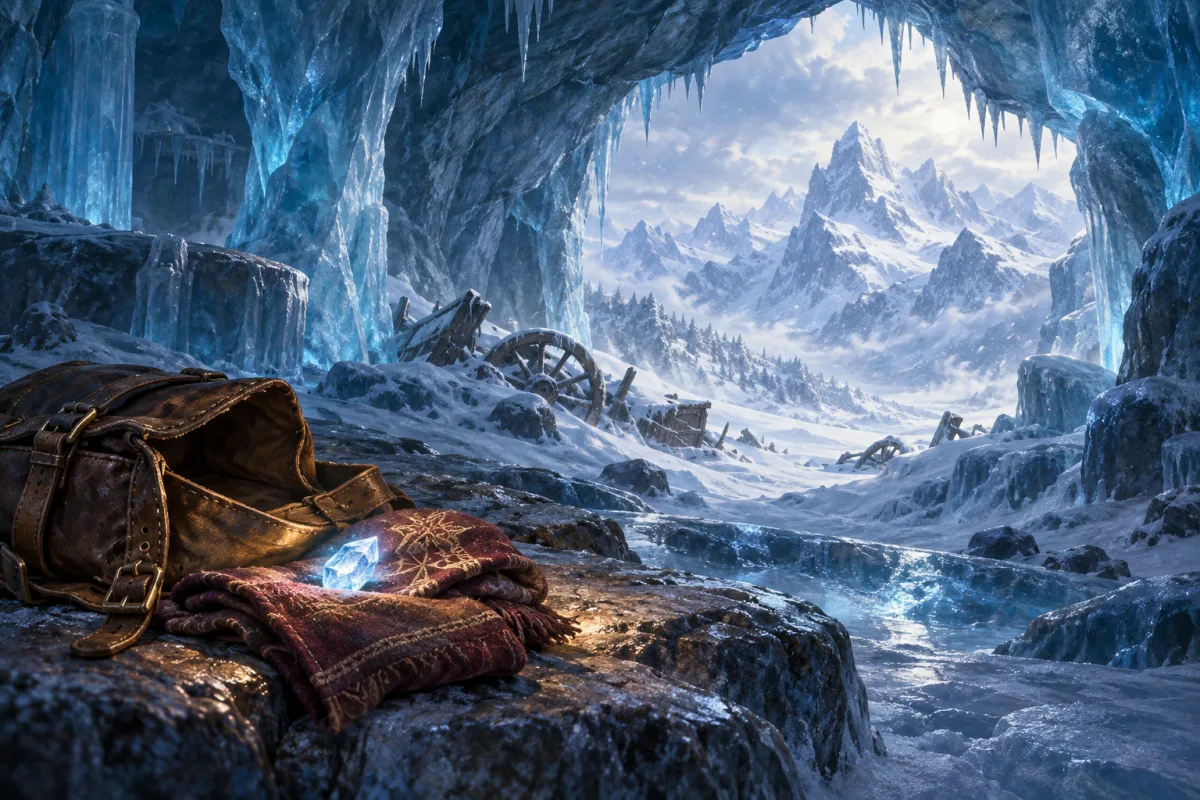
Snow crunches underfoot as they move forward on snowshoes. The wind intensifies. Eventually, they reach an ice cave carved into the tundra.
The entrance is unsettling.
Blood stains the ice. Wooden posts stand nearby, marked with crude warnings. A mammoth carcass lies partially frozen near the entrance, massive tusks jutting out from the snow. The writing suggests territorial warning—keep out, claimed ground, fractured clan markings indicating a splinter faction.
Lana recognizes enough to understand it is not a single unified group, but something divided.
They discuss what it might mean. Kroak wonders about the structure of the faction. Ruben tries to piece together what they are walking into. Daiki studies the cave, uncertain but alert.
Then movement.
Inside or just beyond the cave entrance, something shifts. A figure stands near the wall. Not fully clear in shape, but present—watching.
The group halts at the threshold, the cold wind behind them and the unknown waiting ahead.
The inscriptions are clarified by the surroundings: they are warnings. The meaning becomes loosely understood as something like correct territory markings and a “stay out” message tied to a faction or splinter group.
Inside, a massive frost giant stands waiting. The group approaches cautiously. Ruben insists on following those who understand customs, while Lana tries to establish peaceful intent: “We come in peace I… don’t know what to say.” Kroak emphasizes speaking calmly, and Daiki observes the sheer size of the giant, comparing it to something overwhelming and godlike.
The giant, later understood as Scardi, speaks in broken, mixed language about territory, hunters, and being displaced. He mentions their previous home in the Spine of the World, their clan, and injuries caused by dragon fire. His voice carries grief and frustration about his son being injured.
“door drakenvuur Medicijnen maar werken niet,” he explains, questioning whether the strangers are truly here to help.
Daiki questions the dragonfire wounds and begins analyzing whether they stem from a white dragon. Ruben prepares magical assistance, noting that Comprehend languages would help him understand everything spoken.
The group moves deeper into the ice cave. Kroak engages the giant in conversation while Lana repeatedly struggles to translate. Scardi explains further: their son is injured, and the wound resists healing. The group learns that healing attempts have failed and the situation is worsening.
Inside the chamber, the frost giant son lies wounded. His body shows a severe burn-like injury. The father attempts to treat it with snow, but Kroak notices it makes things worse. Ruben confirms via observation that the wound is not normal: something magical is inside.
Ruben concludes, “So there’s a shard in maybe a remnant of a magnificent dragon attack… pure cold magic… I think the only way to save this kid is to remove it from the body.”
Kroak offers assistance with tools. Daiki explains, “I actually can absorb magic,” suggesting a joint approach. Lana translates everything the group discusses.
A plan forms. Ruben prepares surgical removal, Kroak assists with medical skill, and Daiki prepares magical absorption and Lana supportive healing and translating every move the group makes. The group coordinates carefully.
Ruben warns, “So maybe I use some chalk on the body,” then escalates to requesting tools. The giant provides a knife. Kroak comments on improvised surgical equipment, while the group debates sedation and safety.
Daiki quietly begins casting supportive magic, including lesser restoration and subtle enhancements, while trying to absorb part of the shard’s energy.
Ruben prepares carefully and declares success in precision: “So I really try to cut it out.” The wound opens, and the giant screams as the shard is exposed. Blood flows as the operation begins in earnest.
“Get your equipment out,” Ruben urges, as healing magic stabilizes the patient. The group works together—healing words, restoration, and stabilization reduce the bleeding.
The shard is finally visible: glowing, crystalline, and embedded deeply in the body.
Ruben directs coordination: the mage hand moves in, Daiki channels energy, and the group extracts the shard together. The wound closes partially, leaving scars but stopping the worst of the damage.
The frost giant breathes easier.
Scardi and the father respond with relief, though recovery is still needed. The group debates what to do next. Ruben explains the magical nature of the shard, and Daiki notes absorption potential. Kroak confirms medical stability.
The shard is secured into a bag of holding, wrapped carefully.
Shortly after, an elder frost giant shaman arrives, casting bones and interpreting omens. She declares signs of recovery and future cold paths. The atmosphere shifts from crisis to resolution.
The family thanks the group. Scardi’s father declares they will return to hunting and continue their lives. A sigil is offered as gratitude, heavy and symbolic, marking their clan’s identity.
Additional minor magical items are offered, including supplies and a small figurine: a silver raven used for cleaning nails. It is identified as a magical object, likely usable for communication or utility magic. Kroak recognizes its significance, while Ruben reacts cautiously and curiously.
Eventually, the group returns to Bryn Shander, where they are received as survivors and heroes. Council members acknowledge their success, except for Myra, who assigns the actions to her great judgement.
Lana stands overwhelmed while being recognized. The group presents proof of their interaction with the giants. The council reacts with approval and satisfaction.
Back in the inn, Lana’s parents celebrate her return proudly: tankards are raised. The group toasts together – to the north, and to friends.