Session 18 — 31 May 2026
Expressions and interests
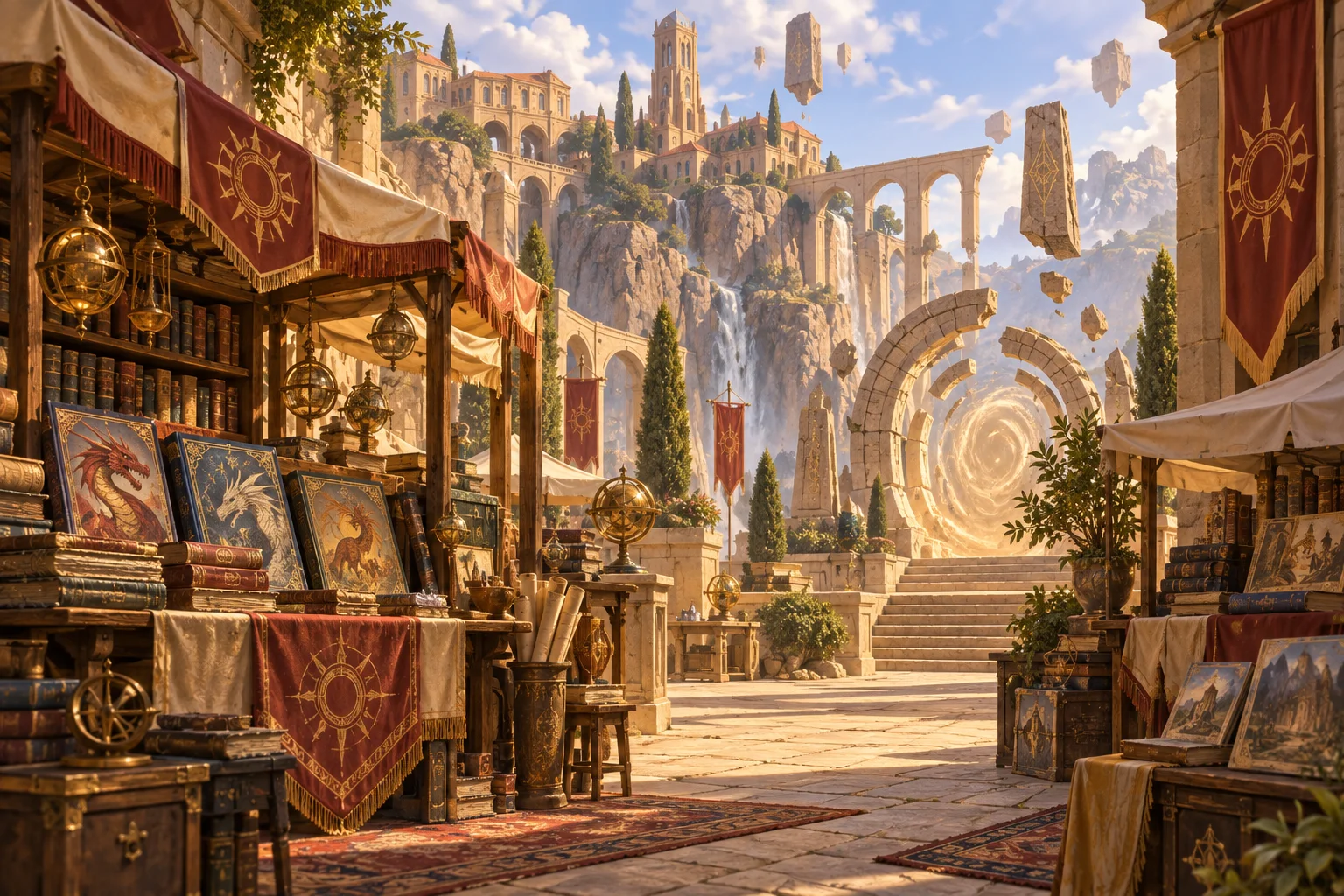
The group leaves the central teleportation hub and makes their way toward Lorehold. The portal itself feels old and dusty, with grains of sand seemingly floating through the air. The scent is stale in the way ancient books are stale, yet somehow pleasant. Stepping through, they arrive on the Lorehold campus beneath a blazing sun.
A massive hall towers nearby, while the familiar round building that houses the offices stands on the cliffside. This section of the campus is new to them. Students fill the area, and countless stalls line the pathways. Floating stones drift in orderly patterns around the surrounding mountains, resembling those seen at Archway Commons. Whether the phenomenon is caused by magnetism, magic, or something else entirely is impossible to tell.
Sszethik gazes around with obvious excitement. “Oh, thisss isss ssso cool.”
Books dominate many of the stalls, as expected of Lorehold. There are reading areas that resemble outdoor libraries where students pore over historical texts. One exhibit looks vaguely like Dragon Chess, except animated figures reenact battles across a detailed battlefield model. Elsewhere, students queue at what appears to be a magical item appraisal booth.
Ruben glances at Sszethik and Daiki. “Well, Sszethik, is this your first time on Lorehold campus? And what about you, Daiki?”
“Of course not, Ruben,” Daiki replies. “I was here with you when we were questioning that Professor Talos. That was really stupid. Remember?”
“Oh, well, yeah, but maybe watch your words a little more carefully here. The walls and the statues, they have ears. They remember.”
Daiki freezes. “Oh. Oh yeah. Oh wait, the Dean is behind you.”
Ruben gestures around them. “It focuses on the living history of the past. What can objects tell us? How can we learn from spirits of the past? Military history, societal history, cultural history. To be honest, I haven’t read the program. I’m not sure if it’s as exciting as Witherbloom.”
“Yeah, yeah, yeah, yeah,” Daiki says. “Let’s go look around and see if we can learn about the history of dragons.”
Without waiting, he darts away.
Daiki weaves through the stalls in his own unique fashion. While others browse normally, he hovers over displays, flying from stand to stand with remarkable efficiency. At first he searches for dragon lore, but eventually broadens his focus to include anything concerning the Spellplague.
Among the books, one immediately captures his attention.
Its title reads: The Fantastical Fanfare of the Founding Fathers of Strixhaven.
The book focuses on the founding dragons of Strixhaven, detailing their forms and their history.
“Ooh. This is a great find. I found a book of the founding dragons. Lovely.”
The purchase pains him slightly. The tome is enormous by his standards, roughly the size of a world atlas and packed with illustrations. Delighted, he immediately carries it away.
Soon he returns to the others with the massive volume practically flying beside him.
“Oh! Oh! Look what I found! Look what I found!”
He turns the cover toward them.
Ruben studies the title and smiles. “Well, this is a great find. I think they put great effort into creating a title that has five F’s in it.”
“Yeah! Well, I’m going to read this.”
Finding a shaded spot beneath one of the arches away from the heat, Daiki waves goodbye.
“I’ll be over there reading my book. So good luck on your trip together. Bye!”
“But Daiki, don’t you want to—”
He is already gone.
Sszethik watches him leave. “Is he always this excited?”
“Oh yeah,” Ruben replies. “If it involves dragons or something shiny or something sweet, absolutely.”
“That is so nice. But most things are shiny or sweet on campus here, no?”
“Well, yeah.”
While Daiki immerses himself in dragon lore, Ruben and Sszethik wander the market together.
Ruben hopes to learn more about Lorehold’s spirit statues and perhaps find information connected to Cult that could serve as a gift for Sszethik’s family. They examine maps and archaeological displays run by students. Many of the maps are hand-drawn, evidence of the expeditions Lorehold students undertake.
The map of Cult they find is particularly disappointing. Vast portions remain unexplored, marked only by jungle and warnings of danger. Sszethik’s homeland lies somewhere in an unmarked region.
“There seems to be not much knowledge about it,” Ruben remarks.
“Well, maybe,” Sszethik says. “But we’re living off the grid. Some people do not accept us, so we live off the beaten paths.”
Ruben studies the map thoughtfully.
“So actually, if I would present a map, it might be quite offensive then.”
“Maybe. Maybe you can present the map to the nearby places.”
Ruben decides against it.
As they continue walking, he bumps into Sszethik.
“Oh, I think I also ran into something—someone nice.”
He keeps moving before waiting for a response.
Sszethik merely follows, visibly pleased.
Together they spend more time exploring Lorehold. Ruben learns about the spirit statue mascots. Students regularly study alongside them, interact with them, and allow them to wander the campus. The statues are common sights, animated constructs intertwined with Lorehold culture. Ruben and Sszethik even speak briefly with older students who use them.
Later, while strolling among the exhibits, Ruben broaches a more personal topic.
“You mentioned that in your culture the matriarch determines the direction of every family member’s life. Relationships and things like that. Is that only until a certain point, or can you choose freely before then?”
Sszethik thinks for a moment.
“My brother is older than me, and he was assigned a wife. I was told I could finish my studies because I really wanted to study at Strixhaven.”
Ruben’s smile grows impossibly wide.
“Okay. Well, that’s at least four years.”
Sszethik simply nods.
Eventually they return to collect Daiki.
The tiny dragon practically bursts with excitement.
“Oh! Oh! Look, look, look! Did you know that probably the Lorehold dragon—did you know the name of the Lorehold dragon? I just read that it’s a she, and her name is Velomachus! That’s really cool, isn’t it? She’s probably the first one to master magic here. Oh, this book is so interesting.”
Ruben laughs.
“Oh wow.”
Daiki flips through pages until he finds an illustration.
“She looks a bit scary though. Like a big red dragon with a white belly and lots of scrolls. She almost looks like a mummy, you know? A mummy dragon. Which is really funny because she’s also female, so it sounds like a mummy. Maybe she’s very parental. I don’t know. Anyway, are we done here?”
With Lorehold explored, attention turns toward Prismari.
Sszethik hesitates.
“I do want to study a bit more in the Biblioplex, so I’ll leave you for Prismari. I think some of your other dormmates wanted to join you there.”
Daiki blinks.
“Are you not coming to Prisma House?”
“I am afraid not, but I wish you all the fun. I am not made for Prismari. It is not for me.”
“Why? Is it because Ruben wants to buy a present over there, so you want to see it as a surprise or what?”
Sszethik glances at Ruben and smiles.
“That is ssso ssweet. No, no, it is not because of that. But that is also good. I have to go, but I wish you a lot of fun at Prismari, and I’ll sssee you guys tonight.”
“I look forward to seeing you, Sszethik.”
“It was a lot of fun. I alwaysss like hanging out with you. But we’ll sssee each other tonight. Don’t worry.”
Ruben struggles to interpret the answer. Countless possibilities race through his mind.
In the end, he simply steps forward and offers a hug.
Sszethik hugs him back.
Then the group parts ways.
Back at the central campus, they regroup with Lana, Kroak, Alex, and Nymri before heading for Prismari.
As they walk, Daiki enthusiastically shoves his new book into everyone’s faces.
“Oh, look, look! This is where we’re going now! This is Prismari, and I don’t know the name—wait one second—Galazeth! Galazeth! Look at Galazeth! Don’t they look amazing? Don’t they look amazing?”
Everyone is required to participate in the dragon hype.
The moment they emerge onto the Prismari campus, they are engulfed by light, color, and sound.
Music echoes from every direction. Somehow countless individual performances merge into a single harmonious whole. Painters work at easels while magical lightning, fire, illusions, and color swirl through the air. Every imaginable form of artistic expression fills the campus.
Alex and Nymri stop immediately.
“Whoa.”
Ruben surveys the spectacle.
“Oh, they sure know how to sell this. A lot better than Lorehold.”
Daiki is enchanted.
He asks about Prismari clothing, already imagining how he might dress if he joins the college. He studies the students’ outfits, fascinated by the flowing colors and artistic styles. When he learns that the official college attire comes later, he begins mentally planning his future look.
The discovery that Octavia, the enormous octopus-shaped water elemental known as the Living Thesis, is somewhere on campus only increases his excitement.
Ruben unfolds a Prismari brochure.
“I will be interested in the Electrovisionary division. Maybe we can get something nice as a present for Sszethik’s family. Something with light, lightning as a paintbrush perhaps.”
“You want to bring an expensive gift?” Lana asks.
“Well, maybe. We’re thanking them for their hospitality.”
Kroak grins.
“Yeah, yeah, we should bring them a potato.”
“Just like you brought my father potatoes,” Lana replies. “It was very exciting.”
As the discussion continues, Kroak explains they mostly came to socialize.
Daiki suddenly has an idea.
“You know there is so much magic here. I assume the water is loaded with magical energy. What if you scoop up some water and make really, really enhanced magical potions?”
“What kind of potions?”
“I don’t know. Experimental potions. You make them, right?”
Kroak considers this.
“That’s true.”
They pull out a vial and fill it with Prismari water.
“I’m sure it will come in handy one day.”
“One day when you’re thirsty,” someone remarks.
Meanwhile, Ruben follows signs toward the Electrovisionary artists.
There he finds painters creating stunning works with magical techniques. One artist in particular catches his attention.
Ruben awkwardly stands nearby, waiting for an opportunity to speak. Unfortunately, his attempt at being polite mostly results in him hovering uncomfortably close behind the painter.
Eventually the artist finishes.
Eyes emerge from behind painted mountains, watching from the canvas.
“Bro,” the student says. “Sup?”
“Hi. I’m Ruben. I’m looking for a gift for the parents of a fellow student where we’re going to spend our midsummer break. Do you do commissions?”
The artist lights up immediately.
“Bro. You totally inspired me. What is the commission?”
Using minor illusion, Ruben projects an image inspired by Sszethik: serpentine imagery and striking eyes.
The artist studies it carefully.
“Bro, I totally feel you. I’ll make the picture of your special someone. No worries at all.”
“How much would that be?”
“Bro, art is to share. Art is for free. It’s for anyone.”
Ruben is stunned.
“That’s most appreciated.”
“Inspiration is all I need. And you, my bro…”
The artist places a hand against Ruben’s chest.
“You filled my tank right up.”
Ruben blushes furiously.
He clarifies that the painting is intended as a gift for Sszethik’s mother and refines the illusion. The artist immediately begins working.
Lightning dances from his fingertips, etching color directly into the canvas. The result is unlike any painting Ruben has ever seen.
Soon a finished piece rests in his hands: a small canvas depicting a beautiful serpent with watchful eyes hidden beyond it.
“Wow.”
Kroak and Daiki admire it.
“I love his work,” Daiki admits.
Curious, Kroak asks the artist’s name.
“Bro, it’s not relevant. Just call me bro.”
“Alright. Not relevant, bro.”
Daiki immediately has questions.
“Are you a student? Do you love that teacher—what is her name again? Nazari?”
“Bro, I love that class. I always do so well.”
“I heard she created an earthquake or something.”
The artist waves the concern away.
“Totally great class, bro. You learn so much.”
Afterward, Daiki quietly informs the others, “I think he smells too much.”
Ruben only shrugs.
“Well, I don’t mind what he does, but I love his work.”
While this unfolds, Lana spends much of her time with Alex. Together they watch musicians whose performances combine instruments with magical fire, lightning, and light.
Alex seems amazed by everything.
“What do you think, Lana? Do you already know what you want to do?”
“My first choice is actually Silverquill.”
“Really? I didn’t peg you for Silverquill. You’re always so expressive on the violin.”
“That’s because you haven’t really seen me outside of practice. I tend not to be that expressive when I’m not playing.”
“But do you like playing the violin?”
“Of course. But I haven’t really thought of it being my career. I want to be a politician.”
Alex looks genuinely surprised.
“Wow. I did not peg you for a politician. I think you’ll be great as a politician.”
Their conversation drifts through music, orchestras, scholarships, and Aurelia’s demanding standards.
As they continue walking, Lana notices that Alex is warmer with her than with most others. Familiarity from practicing together has clearly deepened their friendship, and there is a subtle sense that perhaps something more could someday exist between them.
Elsewhere, Kroak seeks out Aurelia.
The older student stands watching the crowds like a hawk, searching for talent.
“Hi. Are you working?”
“Working? Well, always. Always looking for talent.”
“You look very busy.”
“Relaxing doesn’t create art. Art gets created when you try really hard.”
Kroak immediately challenges her philosophy.
“I just talked to some bro, and he kind of said the opposite.”
“He’s wrong.”
The debate escalates from there.
“What’s art about then?” Kroak asks.
“Winning and expressing in the best possible way.”
“How do you win at art?”
“You do better than everybody else.”
“Isn’t it subjective?”
“No. Art is objective. It is either good or it is not.”
Kroak seems unconvinced but amused.
Eventually the conversation shifts to Lana’s musical practice.
Aurelia reveals that she thinks Lana has tremendous potential, though she refuses to tell Lana directly.
“Why would you ever tell her?” Kroak asks. “Did you think that would motivate her to become better?”
“If people think they’re already good, they won’t become better.”
Kroak grins.
“Well, I think you’re very good.”
“You don’t know.”
“That’s my subjective opinion.”
“That’s not an opinion for you to have.”
“I still have it.”
Aurelia sighs.
“Well, I’ve got other things to do. And you clearly are far too busy to have this chat.”
“Yes, yes. I’m looking around for new talent. Good luck. Have fun on Prismari campus.”
And so the group continues exploring the vibrant, chaotic, endlessly creative world of Prismari.
Around them, the group is still on the Prismari campus, the mid-summer warmth pressing down on everything. Ruben looks around and asks, “Is there anything to eat on this campus?”
Ruben clarifies he is looking for something cold—something like sculpted ice cream, an immersive experience built from ice and chill. The group is assured that such things absolutely exist here. It is midsummer, but Prismari is temperate, and the campus accommodates it easily. Soon enough, everyone finds exactly what was described: ice sculptors crafting intensely cold ice cream, infused with magical chill that clings to the senses.
The first lick is almost catastrophic. Ruben’s tongue sticks to the ice at once, half frozen in place before he carefully peels it away. The others witness it and immediately begin laughing. Lana teases the absurdity of it all, pointing out how they were just in Bryn Shander and should know what cold does by now. Kroak, meanwhile, cannot resist and tries the ice cream as well—only to suffer the same fate, their tongue sticking as they join in the collective brain freeze experience.
Daiki watches all of it laughing, happily enjoying the chaos, not participating in the ice cream mishap but clearly entertained by everyone else’s suffering. Kroak eventually remarks that it takes a while for it to melt off, still stuck in the aftermath of their own experiment.
Ruben, thinking practically, uses mage hand to carry his ice cream so he does not have to touch it directly. Daiki responds instantly, conjuring a white dragon-like chill effect in his hand, acting like a walking refrigerator to keep everything frozen. He proudly declares, “I can be useful,” while maintaining the perfect temperature for the dessert.
Ruben decides he will bring the ice cream to the Biblioplex, thinking of sharing it with Sszethik later, even if he is not entirely sure what will happen when it is finally eaten. There is a brief moment of uncertainty about whether this is a good idea, but it becomes framed as a gift.
Kroak approaches Aurora directly, standing close until she notices. Aurora responds casually, relaxed, simply saying she is chilling and listening to music.
The conversation drifts into questions of art and expression. Kroak asks if others are “better than everyone else,” and Aurora rejects the idea entirely—there is no better or worse, only expression. She even comments that she cannot stand a certain kind of rigid attitude she associates with others, calling some people “very different,” almost alien.
Kroak and Aurora continue talking about campus life and future choices. Aurora reveals she has not chosen a house yet, though her parents have strong expectations for Witherbloom. There is mild frustration there, but also resignation. She even considers poking at them with Prismari influences just to see their reaction.
The conversation moves to music. Aurora is part of a showband association, which she describes as collaborative and less rigid than formal ensembles. They play together, perform regularly, and experiment without excessive structure. Kroak shows interest and asks about upcoming performances, and Aurora welcomes them casually, saying they are free to join whenever.
After this exchange, Aurora drifts back into the music and leaves the interaction behind, continuing her day.
Kroak, watching her go, comments on how strange everyone here is. The group briefly laughs and agrees that the campus is full of unusual personalities.
The scene transitions toward the Quandrix and Silverquill campuses. Eventually, the group finds themselves gathered at Silverquill, where an ink fountain sits at the center of a busy social space. People debate, argue, and perform structured conversation like performance art. Contracts are drafted, arguments dissected, and rhetorical precision fills the air.
Lana is immediately drawn in. She watches like a hunting dog locking onto movement, scanning every discussion with intense focus. She moves toward groups debating and tries to observe patterns, techniques, and structures, trying to understand how arguments are built compared to what she knows from Bryn Shander. She is completely absorbed.
At one point, she finds herself unintentionally standing within a circle of people raising glasses in a toast. Without realizing it, she is part of it. A voice calls out celebration—“to a great year and beyond”—and soon the entire group joins in structured ritualized toasting.
Lana suddenly finds herself holding a glass as well. The moment feels inevitable. She thinks about her devotion, yet when prompted, she raises the glass and declares, “To ambition.”
The group echoes the sentiment. Others add their own variations, including praise for Silverquill and the “best dorm.” The ritual continues, shifting from person to person like a wave of collective rhetoric.
Daiki joins in too, raising a toast to “The Heroes of Strixhaven,” and adding small fireworks behind him for flair. The effect draws mixed reactions—some disapproval from more formal participants—but it only reinforces the contrast between expression and structure in the space.
Lana, however, feels something different. Watching the reactions, she feels strangely aligned with this place. The focus on purpose, argument, and meaning resonates with her deeply. Even Daiki’s fireworks make her feel more certain about her own belonging, even if she does not fully articulate why.
The group continues through more structured conversation circles. Kroak, meanwhile, begins a social experiment of sorts, engaging multiple Silverquill participants in conversation and keeping them engaged with follow-up questions so they cannot easily leave. It becomes a steady flow of polite entrapment through curiosity and dialogue.
Eventually, the group begins to wind down the Silverquill visit.
Warming up in the Biblioplex
The Biblioplex is quieter, softly lit, almost empty compared to the earlier campuses. Ruben arrived there earlier carrying the preserved ice cream, still using mage hand to keep it steady and intact. In their usual study corner, Sepik is already present, surrounded by books.
Ruben approaches, guiding the floating ice cream forward with a small flourish of Prismari magic. The effect is playful and slightly theatrical, enough to catch attention. Sszethik looks up, smiles, and waves.
Ruben explains the ice cream, describing it as a Prismari creation and something they brought specifically so Sszethik would not miss out. The flavor mix is pineapple and vanilla, chosen thoughtfully, even if a little uncertain in combination. Sszethik reacts warmly, thanking him and deciding to let it warm slightly before eating.
In return, Sszethik produces books—materials about Cult, intended to help preparation and study. It is thoughtful, practical, and clearly meant as encouragement. The conversation turns naturally toward academics, with talk of arcanobotany and studying harder after Ruben’s recent challenges.
Ruben admits disappointment about earlier performance but expresses determination to improve. Sszethik reassures him, saying more study will help and that the subject is enjoyable.
As they talk, the conversation gradually shifts from academics to something more personal. Ruben asks about cultural differences and even about courting practices in Sszethik’s background. Sszethik explains awkwardly that arrangements exist in their culture, often involving expectations of purity and family decisions, though they themselves have little personal experience with it.
Ruben gently responds, offering perspective instead of pressure, describing what genuine attention and admiration might look like—care, kindness, interest in another person’s thoughts and needs.
The realization lands quietly. Sszethik admits no one has ever shown interest in him like that before, that he was always overshadowed by others in their family. There is vulnerability there, unspoken but present.
Ruben carefully takes his hands, seizing the moment to express that Sszethik embodies all the attributes he just mentioned. Sszethik freezes slightly at first, taken aback by the directness, but does not pull away. Instead, there is quiet stillness, processing rather than rejection.
Ruben, sensing the importance of consent and comfort in the moment, softens his approach immediately. He acknowledges the situation clearly and steps back emotionally while still staying present, offering support instead of pressure. He simply says he cares, and that others here do too.
Sszethik responds softly, saying they enjoy spending time together and would like Ruben to stay. There is relief in the simplicity of that statement.
Sszethik then shares something personal: a place in Cult he has always wanted to show someone—a beautiful overlook, meaningful and private to him. He expresses a desire to share it together.
Ruben agrees without hesitation, saying he looks forward to it.
In the Biblioplex’s quiet light, surrounded by books and slowly warming ice cream, the moment settles into something gentle and unspokenly significant as the day finally begins to wind down.