Playing to your own strenghts
29 March 2026
The notorious doll, Sassy Sally Jane, is still at the center of the group’s investigation, clutched under Lana’s watchful eye as holy water glints threateningly in her hand. The doll recoils from it, wincing as though the sight alone pains her.
Lana’s voice stays sharp and steady. “I will not ask again—where do you come from, and what are you doing with all these weird things going on?”
Sally snaps back at once, shrinking away. “Okay, okay, okay. It’s not me. Don’t pour that filthy stuff over me.”
“I will not,” Lana says, “but you have to tell me the truth.”
The doll sneers. “You smell, but so does where I come from.”
Daiki leans in, trying a different angle. If they let her go, can she lead them there? Sally answers with all the spite they have come to expect: “I could, but do I want to? No.”
“Then we put you on a leash,” Daiki says, only for Lana to immediately agree that she had been about to suggest exactly that.
Sally laughs bitterly. “I’ll escape. I will escape from your filthy grubby hands.”
Ruben crouches down, attempting diplomacy where threats have failed. He asks what it is she actually wants, why she is sitting in a storage room in the middle of all this. Her answer is venomous and immediate: “I want to stop seeing your ugly face and filthy hands.”
When Ruben presses whether that is truly her greatest desire, she bristles even more. “Don’t talk to me about desires, you pervert. I don’t want to be exposed to your desires.”
He gestures toward Lana with dry amusement, suggesting perhaps Sally should direct that accusation elsewhere, but the doll is quick to correct him. “No, no, no. You touched me. She didn’t touch me. She’s just almost pouring that filthy stuff over me.”
Eventually Ruben steers the conversation back on course, reminding Sally that she is supposed to be bringing them to her location. This time she yields a little more easily. “Sure, sure. Let’s take a little boat trip.”
That mention of boats immediately shifts the group’s thoughts toward Witherbloom campus. Ruben recalls that the only real boats on campus are the ones students use to cross into Sedgemoor’s bayou—a wild, dangerous wilderness. The implication of danger settles over them quickly: if Sally comes from anywhere, it is likely there.
Even so, distrust gnaws at Ruben. Sally is almost certainly untrustworthy. She might lead them into a trap, or simply send them in the wrong direction.
As they debate whether magic might force better answers out of her, the conversation is interrupted by the arrival of two professors. Professor Lang approaches alongside a Silverquill professor the group has not yet met: Professor Totski. They confer with Professor Vantrax and begin discussing the strange incident, the traces of Eldritch Balm, and the peculiar reaction the doll has to holy water.
Before the group can return to strategy, Daiki points out Kroak, who is barely standing after the recent fight. “Professor, excuse me… a friend over there is like almost dead.”
Professor Totski immediately hurries over and tends to them, feeding them two healing potions. As Kroak drinks, some of their nastier wounds begin to close. They exhale in relief, explaining that they had to deal with the owlbear, and thank her as strength slowly returns.
Lana asks what should best be done with it—whether the doll should be threatened further, or whether the holy water has another use.
Professor Totski’s focus sharpens. He believes the holy water should be used more carefully. One of the springs that feeds the creation of Eldritch Balm in the bayou may have been corrupted. Students often practice magic out there, and something must have slipped into the water source.
That revelation makes the path forward suddenly clear. Daiki immediately asks if they should go to the bayou, and whether they are even allowed to.
Professor Vantrax and Professor Lang exchange a meaningful look before answering. They tell the entire group that, based on the potential they have shown so far, they should be capable of handling this task, yet should ensure their full magical capabilities are available when they set off.
The practical issue soon becomes when to go. The Rose Festival is still in full swing, with more performances, markets, and events scheduled, and Witherbloom campus itself is nearly deserted because everyone is gathered elsewhere. That makes the bayou even more dangerous: if something goes wrong, no one will be there to help them.
Ruben asks whether anything like this has happened before—whether Sassy Sally and the Eldritch Balm incidents are new. Professor Vantrax explains that while this specific case is new, the doll has appeared around campus many times over the years. Wherever she turns up, strange things tend to follow. Yet strange things can happen without her as well, making the mystery all the more frustrating.
That only deepens Ruben’s resolve to dig through the archives later.
Ruben worries aloud that time is pressing, because Sally tends to disappear after incidents, but the professors point out that they no longer need the doll herself—only the information she can provide.
That sparks Lana’s next attempt. Since she is too drained to use stronger magic, she instead reaches out telepathically, slipping her thoughts into the doll’s mind. Rather than her own voice, she makes it haunting and authoritative, trying to sound like Sally’s creator.
The doll’s reaction is immediate panic. “Get out of my head! Get out of my head!”
Lana presses harder, refusing to leave, and the mental pressure finally cracks something loose. Sally blurts in jagged fragments, out loud this time: “It’s there, it’s there, it’s there. The boats. It’s there. The spring.”
The words are vague, but Professor Lang freezes with sudden recognition. She knows the place: a spring near the research shed in the bayou, one of the water sources used for Eldritch Balm, farther away from the main processing plant.
Now they know where to go, and jointly decide to go after the Rose festival.
Daiki is the first to pivot away from the immediate crisis. Since they have time before the eventual journey, he suggests shopping among the festival stalls for magical items and useful supplies. Secretly, he has a more personal idea brewing.
Ruben and Lana instead head for the Biblioplex, determined to search the records for mentions of Sassy Sally and similar student deaths or incidents in Strixhaven’s history. Lana joins him. In the archives, Ruben uncovers that the doll has long held a certain campus notoriety. Long ago, she was simply enchanted to insult random people. Yet none of the older stories carry the same insidious darkness this current version does. The insults were once sharp but playful; now they are crueler, more malicious, more cursed. Whatever Sassy Sally has become, something has changed.
As they work, Lana confides her discomfort with the professors’ decision. Waiting feels dangerous to her. Chaos still looms, and every moment leaves room for more calamity. Ruben, ever more philosophical, muses that this tension between order and chaos feels deeply Strixhaven. “Maybe you should talk to the student counsellor, if you’re uneasy about these kinds of stuff” he says. The professors prefer order, but there must always be a boundary—some point where action becomes the better answer.
Their conversation drifts briefly toward Professor Talos and shifting trust, with Lana noting how Ruben’s suspicions of him softened after meeting him in person. Ruben can only shrug and admit Talos had seemed convincing. Eventually the talk moves toward lighter things. Lana mentions her performance later that evening: a string quartet beneath the starry sky, with dancing lights overhead. Ruben mentions his dragon chess event the next day and invites her to be one of the opponents.
She smiles and agrees. “Sure, I’ll be there. Would be fun. Let’s see if we can play a good game.” Some loneliness sets in Ruben’s heart with getting no invitation for Lana’s performance later on.
Elsewhere, Daiki and Kroak head for the market stalls. Inspired by the dragon statuettes sold there, Daiki spends thirty gold gathering small idols of the Founders’ dragons. Over the course of the day, between performances and festival events, he carefully melts and fuses them together with small bursts of magic—Prestidigitation, Druidcraft, little flames and careful shaping—forming a beautiful orb containing all five dragons within it. It is part crafting project, part personal milestone, and part preparation for the stronger magic he intends to wield.
The next day unfolds beneath the lively hum of the outer market, where the festival feels brighter, louder, and far more alive than the formal stage spaces. This is the part Ruben has truly been looking forward to. The open air suits him better, and the energy of the crowd already gathering around the stalls feeds the excitement in the air.
By the time he and the others arrive at their designated place, Rampart is already there, exactly as expected—earlier than everyone else, already directing the setup with his usual commanding confidence. As they approach, Rampart greets Ruben warmly. “My boy, my boy! How are you?”
Ruben smiles, though his nerves show through in the words he chooses. He remarks that after yesterday’s nasty incidents, he is almost certain someone will end up injured today, though hopefully not during his Dragon Chess exhibition. More seriously, he admits he wants to be sure there is no Eldritch Balm anywhere near the boards. He wants to concentrate without any unnecessary fuss.
Rampart laughs the concern away, proudly insisting that they would never use such things on their chess pieces. The wood must be felt directly, he says, and besides, they have Strixhaven’s heroes among them. He immediately asks after Ruben’s friends.
Daiki steps forward with an easy greeting, and Ruben quickly introduces him as one of his roommates, making sure there is no awkwardness despite Rampart having met him before. Rampart beams at this, delighted that Ruben has made such strong friendships, even calling it “very strategic.”
Before the conversation can go much further, Lana arrives.
She approaches at a slow, measured pace, perfectly straight-backed, every movement deliberate and charismatic. Her expression remains cool and unreadable until she steps close enough to tap Ruben on the shoulder, forcing him to turn. “Good morning, Ruben.”
Lana and Ruben have never played Dragon Chess before. Lana has always been elsewhere—at rehearsals, with her violin, or simply too focused on her own pursuits to make space for casual dorm games. She is solitary by nature, not the type to ask others to factor her into their plans. Ruben only seems more excited by that realization. He explains that today’s exhibition should be interesting, perhaps even spectacular, because he has prepared a few surprises for the audience.
Rampart grins at that and announces that he has a surprise of his own. He gestures toward a nearby chest and asks Ruben to open it. Inside is a banner. When Ruben lifts it, the painted image unfurls: himself and Rampart standing back to back, arms crossed, both posed with heroic pride. Beside them are three enormous R’s.
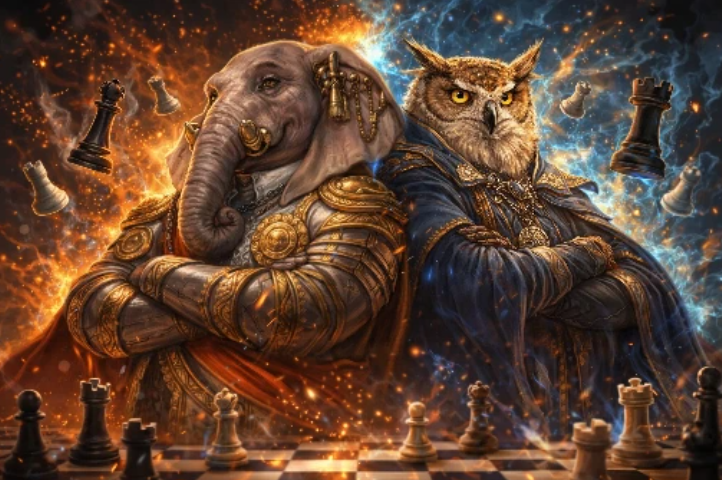
“What do you think, my boy?” Rampart asks, almost vibrating with excitement. “It fits, doesn’t it?”
Ruben laughs and immediately loves it, joking that all it needs now is a Leonin roar. Rampart eagerly explains the true brilliance of the design: “Rampart and Ruben’s Rapids. I thought of it myself.”
“I love it,” Ruben says. “I think it’s catchy.”
Daiki, meanwhile, is completely fascinated by Rampart himself. He peers at him with sincere curiosity and asks, “Mr. Rampart, I have a little question. I’ve never seen one of your kind before. Why do you have a tail as a nose?”
The question sends Rampart into booming laughter. Between amused pops of sound, he proudly explains that it is not a tail at all, but an extra appendage—super useful, in fact. He even lifts it slightly to demonstrate how he can manipulate pieces with it.
“It is not a tail,” Rampart confirms with great dignity. “It is on the front. Tails are at the back.”
Daiki apologizes, but quickly adds that he thinks Rampart looks grand. The compliment lands perfectly. Armor clinking as he shifts, Rampart declares that he agrees completely.
Soon enough, the group turns fully to preparations. Ruben asks Daiki to help hang the banner, and Daiki immediately agrees, taking off into the air with it. When Lana asks if she can help too, Daiki innocently asks if she can fly. Her dry sarcasm is immediate, and even Rampart chimes in that he cannot fly either, proudly declaring that they are “better on the ground.”
Kroak arrives then, scuttling through the crowd and slightly out of breath. “Am I still in time?”
“You are,” Ruben assures them, clearly pleased they came.
The setup itself grows more elaborate than Ruben first imagined. He had envisioned ten boards in a semicircle, all focused on him, but Rampart reveals the full plan: a massive circle of twenty boards, every even board belonging to Ruben, every odd board to Rampart. The space is designed so students can gather all around them, watching both masters weave through simultaneous games.
The festival grounds are already crowded. This is not some slow first hour with only a handful of stragglers. This is the major attraction on campus, and students are swarming toward the boards as the pieces are laid out with ritual precision.
Ruben himself looks immaculate. His clothes are carefully pressed, his feathers preened, his dragon pin polished into proud visibility. He nods to Rampart and asks if he should address the crowd.
Rampart all but orders him to seize the moment.
Ruben rises into the air.
A rumble of thunder rolls across the market as his magic amplifies the spectacle. Hovering above the circle of boards, voice booming, he calls out, “Those who will Dragon Chess salute you! Welcome to Rampart and Ruben’s Rapids!”
The declaration ends a touch abruptly when he momentarily loses his train of thought, but he quickly recovers, inviting everyone—experienced or not—to join the games. He circles above the boards, encouraging students to take seats, while beneath the theatrical confidence there is still a very visible tension in him. He is performing largeness, commanding presence, the image of a proud bird of prey. But those close enough can tell he is scared.
Lana notices. Reaching into his mind with a quick mental link, she sends him quiet reassurance. Hey man, I’m just messing with you. You’re going to be great. Let’s go.
The encouragement lands exactly where it needs to. Ruben thanks her and, in turn, warns her that Rampart plays aggressively, and she may want to pick a defensive approach.
Then the games begin.
Rampart counts down dramatically from three.
At the final one, Ruben adds another flourish of magic, sending tremors rippling through the ground to build tension. The boards shiver. Pieces click and rattle. A few nearly topple, and for one terrible second the spectacle almost ruins the setup entirely.
Still, once the opening chaos settles, the true performance emerges.
Ruben remains suspended high in the air, golden eyes gleaming unnaturally beneath the shadow of his robes. Invisible hands move his pieces across all ten boards while he hovers in the exact center of the ring, a picture of absolute control. The bright banner hangs behind him, completing the image: Ruben and Rampart, back to back in painted glory, while their real selves command the battlefield below.
The first exchanges are rocky.
Daiki, despite barely understanding the game, stumbles into a startlingly strong opening against Ruben, and beginner’s luck carries him through the early phase. Kroak fares less well at first, though they quickly prove capable of adapting. Against the broader crowd, Ruben steadily finds his rhythm, dismantling board after board with clean efficiency.
Meanwhile, Lana faces Rampart. She follows Ruben’s earlier advice and opens defensively, but Rampart overwhelms her with ruthless confidence. Between capturing her material, he lectures cheerfully: “The best defense is a good offense.”
The contrast only makes Ruben’s own past victories over Rampart seem even more impressive.
As the rounds continue, Ruben sharpens. His initial nerves burn away under the pressure of repeated moves, and what replaces them is focus—cold, elegant, absolute. Daiki’s early advantage vanishes as Ruben regains control and methodically strips away his pieces. Kroak manages a strong counter-round at one point, catching Ruben distracted by his success elsewhere, but as the number of active boards dwindles, Ruben becomes terrifying.
By the final rounds, with only Kroak and one last member of the crowd still standing, his superiority is undeniable.
Against Kroak, he becomes flawless.
Every move anticipates theirs. Every counter is exact. The full weight of his mastery presses down until there is simply no room left to breathe. Kroak can only stare at the inevitability of it.
Then only one board remains. The last challenger is a timid student named Zeya, hesitant in every gesture, uncertain in every move—and yet somehow brilliant. Their pieces land in places that seem accidental, only to reveal hidden layers of genius. Ruben meets them carefully, slowing his style into a more defensive rhythm, and the match evolves into a strange and delicate deadlock.
Eventually, Zeya quietly suggests, “Shall we call it a draw?”
Ruben studies the board, then smiles. A perfect finish.
“Well played. Absolutely. I think a draw would be most appropriate,” he says, offering his hand. He adds an invitation to the Dragon Chess Club as they shake.
A thunderous magical rumble marks the end of the game, rolling outward from the final board to the delight of the crowd.
Rampart, finishing his own last games, seizes the moment with typical bombast. He announces Zeya as the crowd’s great victor and demands to know their name before proudly revealing the promised prize: a t-shirt.
Ruben opens the box to reveal neatly stacked shirts, each emblazoned with the same glorious image from the banner—himself and Rampart back to back, the giant triple R beneath them.
He personally hands one to Zeya, leading the crowd in applause.
The exhibition continues in smaller rounds afterward, but the major performance is complete.
Ruben ends the session with nine and a half wins out of ten, only a single draw preventing perfection. He is radiant. The others can all see it: a confidence in him that rarely surfaces so clearly. It is not only in the way he plays, but in the way he carries himself afterward—still threaded with his usual insecurity, but now lit through with pride and adrenaline.
Kroak is the first to say it aloud. “Oh, you did so well, Ruben.”
Ruben laughs, still buzzing from the rush. He thanks everyone sincerely for coming, then blurts out that with this much adrenaline, they absolutely need to party tonight.
Daiki, however, has to leave for the next performance. Lana thanks Ruben for the invitation as well, promising that next time she intends to face him in the dorm rather than accidentally ending up at Rampart’s table.
Ruben smiles at that and tells her he saw some genuinely good strategic instincts in her play.
With violin already in hand, Lana quickly moves off after Daiki, cutting through the crowd at a brisk pace. Soon she is gone down the path toward the next event, leaving Ruben still in the afterglow of victory, hovering just a little longer in the space where, for once, confidence feels natural.
As the rapid games wind down and the excitement of the day begins to shift toward the evening’s performances, Lana heads off with Alix toward the place where it is all going to happen. Nearby, Daiki is already deep in the backstage chaos, scrambling to prepare for yet another show together with Sszethik. He had thought he only needed one performance, and now, realizing there are three, he hurriedly tears apart old battle ideas and rebuilds them into new ones, muttering to himself as he works through the heavy creative labor.
Ruben, still riding the high of the Dragon Chess tournament, lets his gaze drift over the crowd. He wonders whether Sszethik is still there, somewhere among the festivalgoers, perhaps lingering after watching the games. Earlier, Sszethik had clearly been present, watching Ruben’s handling of the board with obvious pleasure, even taking part in one of the rapid matches. The thought lingers with Ruben as the crowd begins to thin into that strange, reflective quiet that comes after a long, brilliant festival day—the moment when everyone else has drifted away and the rush leaves only the afterglow.
As Lana steps away, she thanks Ruben warmly. “Well, I have my performance with the orchestra, Daiki and Sszethik now. If you would like to watch, you’re more than welcome.”
“Yeah. Absolutely,” Ruben says. “I’m happy to join you.”
The group makes their way toward the next show. Daiki and Lana are already preparing, and this time the performance takes on a more refined shape. Daiki, still improvising, decides to repeat the dance from before but asks the ensemble to change the music. This time they choose Roses of the South, and the choreography shifts into a waltz threaded with roses and sweeping movement. Instead of scattered petals, Daiki has the magical roses bloom more fully, turning the stage into something lush and theatrical.
Still restless with invention, he toys with new ideas. Perhaps they tell the story of the heroes of Strixhaven through dance. He hesitates for only a moment at the oddness of performing the legend while being one of its subjects, but quickly decides it is perfect. The dance becomes an epic tale expressed in movement, with Daiki and Sszethik moving in sync as the orchestra tunes behind them.
When the music begins, Daiki throws himself into it. Yet inspiration pushes him further. Rather than the usual dragon-shaped illusions, he tries something new: he reshapes his magic into forms inspired by Lana, Kroak, Ruben, himself, and Sszethik. But on the grand stage, under pressure and without preparation, the spell resists him. What appears are still dragons—one with owl plumage and blue-white robes, one with a braid, another with serpent fangs, another with horns and bat wings. They are echoes of his friends, but all unmistakably draconic, transformed into strange symbolic versions of the party.
From the audience, Ruben immediately recognizes what the performance is referencing: the events of the day before, the fight, the shared memory now retold in dance and illusion. The realization makes him flush, glancing around to see whether anyone else notices. Yet when he also sees that Daiki’s vision is not quite landing as intended, he quietly steps in. With subtle magic—Minor Illusion, a touch of unseen shaping—he overlays owlish details and steadies the magical imagery from the audience, making the forms clearer and the story easier to follow.
The performance flows beautifully after that. Daiki catches the new details in his illusions and simply moves with them, adapting instinctively. By the end, the story of Strixhaven’s heroes unfolds in vivid, shimmering forms above the dancers. When the music stops, Daiki and Sszethik bow deeply, gesturing toward the orchestra in gratitude before slipping backstage.
Ruben rises immediately, clapping hard and enthusiastically. Daiki beams back toward the crowd, calling, “Arigato, arigato! Thank you!”
Kroak, meanwhile, has been enjoying Ruben’s obvious awkwardness far too much. They offer him a tankard with a grin. “Looks like you need this.”
“Yeah, well, cheers,” Ruben says, taking it, knowing his contributions to the Rose festival have completed. Then, with a glance toward Kroak, he adds, “I’m so glad that you could now also see the rest of the fight. I mean, you were unconscious for a while… Lana healed you, but I made sure you were stabilized.”
Kroak blinks. “Really? That’s so nice of you.”
“But I mean—yeah. Cheers.”
“Cheers.”
By the time the Arcanum Ensemble clears the stage and the event wraps, the festival mood has softened into evening. The market bustles with familiar faces—Nymri, Pell, friends, rivals, and all the people they have come to know. There is drinking, laughter, wandering among stalls, and then, as night deepens, the entire atmosphere changes.
The stadium transforms into a candlelit sanctuary.
Students gather candles in warm clusters, filling the vast space with hundreds of small flames. Lana, Alex, and two other members of the Arcanum Ensemble take the center in a string quartet arrangement beneath the starlight. Daiki adds gentle dancing lights above the performers, while a few drift out over the audience like stars. The huge stadium suddenly feels intimate, every candle making little islands of closeness among the crowd.
The quartet sits in a circle—cello, two violins, and a viola—without a conductor, bound together only by their shared rhythm and trust.
As the first notes rise into the night, Ruben quietly uses his magic to shift the candles around their group into a richer golden hue, blending their corner of the audience into the warmth of the music. Lana notices. While she does not break the performance, she glances toward him with quiet approval, a subtle acknowledgment that she appreciates the gesture.
Daiki, inspired in turn, times his dancing lights to bloom upward with the music’s ascent, little bursts of gold rising into the dusky air.
The whole stadium is hushed. Gold light shimmers over faces, candles, and stone, and the first song settles over the audience like honey. Lana’s playing is deeply personal, and as she performs, she keeps catching the eyes of her friends—Ruben, Daiki, Kroak—letting her gratitude show in the smallest tilt of her posture, the gentlest expression.
Her awareness also turns often to Alix beside her. He leads with remarkable ease, his first violin carrying the quartet forward, yet never forcefully. Lana falls into step with him almost effortlessly. His smiles toward her during the bars of the song make the whole thing feel warm, safe, and familiar.
The next song is more melancholy, heavier with feeling. During this one, Lana looks not toward Alix but toward her dormmates, letting the sadness of the piece become a quiet thank-you to them for simply being there.
Later, after the concert, the group slips into the lingering afterglow of the evening. Daiki is still delighted, still buzzing from the success of the earlier performance and the fact that he has finally shaped a style of his own. The festival has given him something tangible—a signature way of performing, even a name for his new magical focus: the Founder’s Orb.
By the final festival day, Daiki leans fully into his earlier ideas. His performance now centers on the five founding dragons of Strixhaven, their colors and magical identities colliding in Prismari reds and blues, Witherbloom greens and blacks, all sculpted into sweeping draconic forms. This time he and Sszethik are far more synchronized, and the story lands with much greater clarity.
At the same time, Kroak’s Potions and Prophecies stall thrives in the market. The stall is lively, staffed by a rotating crew, with banners displaying the new logo and flyers advertising festival discounts. A special rose-scented healing potion, filled with petals for the occasion, becomes a charming signature item.
Not far away stands their competition: Halcyon Potions.
Its owner, smug and snooty, cannot resist needling Kroak at their booth, dismissing their work as amateur and mocking the visible rose petals as poor process control. Kroak fires back with dry disdain, and the rivalry simmers.
Then, during a live potion-brewing demonstration, disaster nearly strikes. One of Kroak’s mixtures begins bubbling violently, far beyond normal reaction. Recognizing the danger instantly, they cool it with a counteragent used in frost potions, turning what might have been an explosion into a dramatic but harmless volcanic overflow of black tar. The crowd, startled at first, watches as Kroak smoothly reframes the near-catastrophe into a lesson.
“It’s always an art to figure out what’s wrong,” they explain, speaking over the fizzing mess, “and if you have enough knowledge, you can always solve it by adding the right ingredients.”
The audience disperses impressed, but Kroak’s curiosity remains. Digging into the ruined flask, they discover the cause: a tiny piece of azurite lodged inside, enough to force the runaway reaction. How it got there remains an unsolved mystery.
Later, Kroak visits Halcyon’s stall, finding it exactly as dull as expected: sterile banners, clinical slogans, and all the boring precision of Quandrix methodology. Yet by needling the owner with intentionally flawed brewing assumptions and near-correct guesses, Kroak gradually tricks him into reflexively revealing pieces of his process—ratios, tolerances, exacting measurements. Kroak files it all away, already imagining how to replicate and improve upon the formulas later.
As the festival reaches its final crescendo, Daiki caps his last dragon performance with one final flourish: the founding dragons collide overhead, and from the burst emerges a giant glowing potion bottle emblazoned with the PP logo, a grand magical advertisement for Potions and Prophecies. The crowd erupts in delight, kazoos blaring.
At last, the Rose Festival closes.
The candlelight concerts fade, the stalls pack away, and the next day promises rest. Yet for the group, the festival leaves them reflective, ready to embark on their journey to Sedgemoor bayou.
Comments are closed