Session 27 — 6 September 2026
The applause is already waiting for them.
“Dear students of Strixhaven!” Daiki calls, without waiting for anyone to stop him. “Thanks for choosing us heroes of Strixhaven as Students of the Year!”
The crowd quiets enough to listen.
“I never knew of Strixhaven,” Daiki continues, “but after Professor Vaelwyn told me about all the cool stuff I could learn here, I knew this place was going to be EPIC! I am so glad I met my best friends here and that we got all these adventures. Imagine if we were not here! Strixhaven would be TERMINATED by these dark events happening here!”
Dean Talonrook looks politely surprised. This is not, apparently, a usual part of the Students of the Year ceremony.
“Bless the Founder Dragons, which I am missing here, by the way,” Daiki says, “that the Heroes of Strixhaven were here to save the day, and the school! On behalf of my lovely friends and I, we will strive to continue to protect Strixhaven from their archnemesis! IKIMASHOU!”
There is applause. Some of it is bewildered, but plenty of people are genuinely delighted. The students they have helped cheer loudly. Ruben and Kroak join in from behind him: spectral dancing fairies flicker around Daiki, while Ruben’s illusions show small, dramatic glimpses of their adventures—the bayou, Neverwinter, monsters, kitchens, and danger.
The images vanish before Ruben can make very many of them. Daiki’s speech has finished rather sooner than expected.
Lana smiles and waves.
She is thinking that this is wildly inappropriate, but she is not about to make a face in front of everyone. That would not help. So she smiles and waves, and lets the boys have their moment.
From the stage, she studies the crowd. Most people look pleased. Some merely look uninterested; not every student at Strixhaven has ambitions toward being Student of the Year. Ari, when Lana catches her eye, only shakes her head.
The faculty are easier to spot. Professor Lang claps and smiles. Professor Vantrax is clapping too, though his face remains as straight as ever. Professor Talos and many others join them. There are more faculty members than Lana recognises. Strixhaven is enormous, after all. It takes a lot of people to keep it running.
Then Dean Talonrook concludes the ceremony. She wishes the incoming students luck with the schools they will choose, and tells them to follow in the party’s footsteps: confidently, proudly, and without wavering.
The next part of the year, she reminds everyone, is the final examination.
It will test everything they have learned.
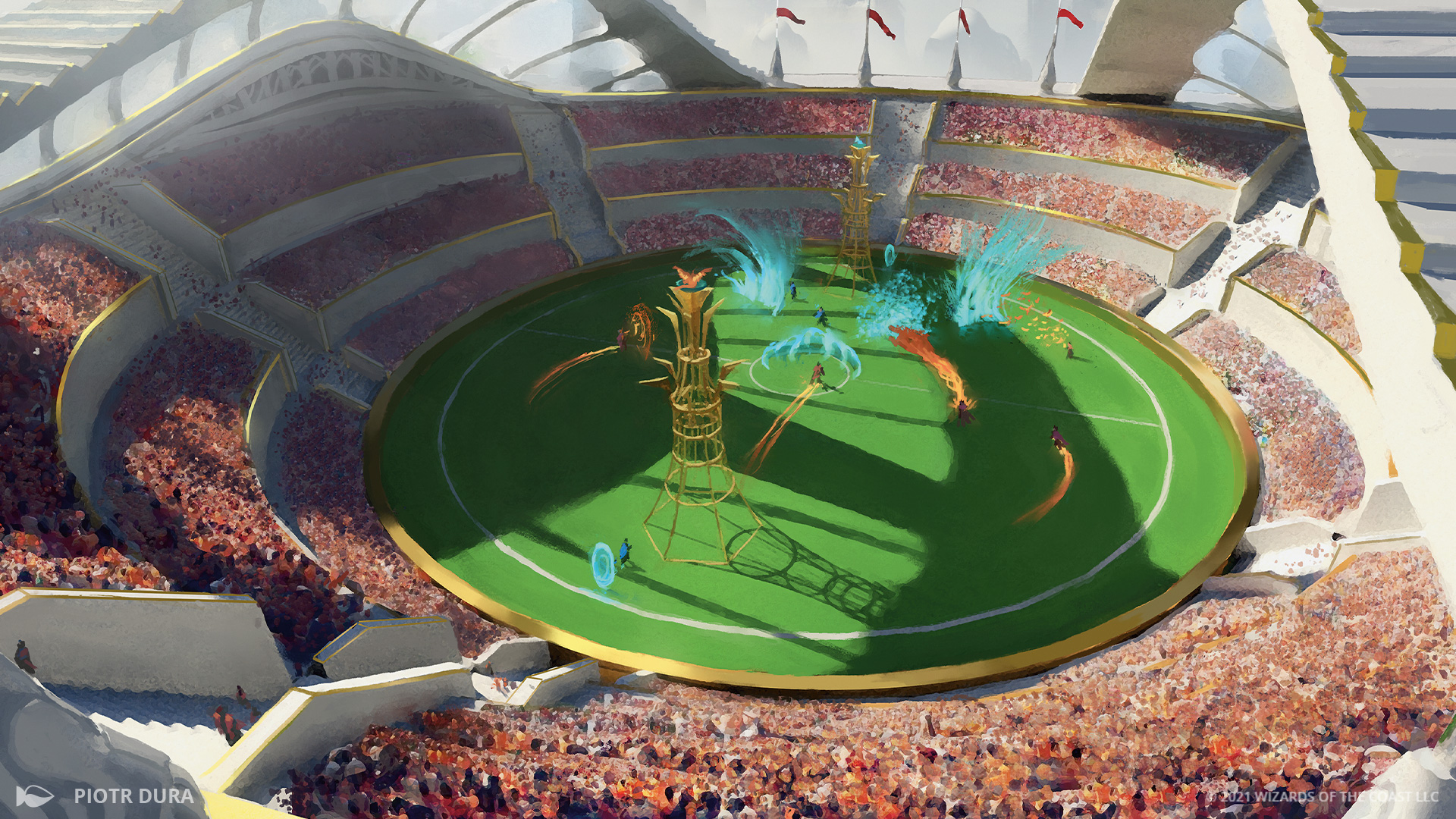
The ceremony is six weeks behind them by the time the first-years gather at Strixhaven Stadium.
The incident in the dressing room has not gone away, exactly. It is simply pushed aside by study, work, clubs, rehearsals, shifts, and the looming terror of final exams.
Lana studies Silverquill incantations with Nymri, because it is fun and because Nymri is good company. She works on her music with Alix and keeps up with the Arcanum Ensemble; her scholarship depends on her excelling there. She still attends debate club because she loves it. Training sometimes has to give way when someone needs her help studying and has no other time available.
With Daiki, she works on Prismari art outdoors. They set up easels and splash paint about with all the enthusiasm of people who have not considered what paint might do to nearby plants.
Then Lana finds an idea she likes better.
Instead of simply splattering colour across a canvas, she uses incantation through music. Her violin carries the spell. Black and gold lines spill over white canvas in curls and swells like the visible shape of sound. Hidden among them are words that matter to her: devotion, ambition, and others she keeps close.
Ruben studies almost constantly.
For Basic Magical Auras, he hosts sessions for other students as well as himself, recognising his Honours program participation. He considers reserving the Lorehold club room and becoming the sort of person who tutors people in a classroom. It is, Lana informs him, extremely professor-like.
He studies magical physiologies through his work as a dissection assistant. For Lorehold archaeomancy, he investigates items from their adventures, explores campus, and speaks to second-years and Rampart. For Witherbloom, he works with Sszethik and tries to improve at arcanobotany. He also makes time to thank Bro for the electro-visionary image he had created for him, which was appreciated.
Daiki prepares with the confidence of someone who intends to make every subject beautiful.
He practises elemental art, especially the dragons he shapes from colour and magic. He trains his senses for Basic Magical Auras, tasting, smelling, touching, hearing, and looking at anything likely to be magical. In the Feywild, where time is kinder and stranger, he visits magical creatures from home and asks them questions.
What does a kitsune’s magic do? Where does it come from? What is the function of nine tails? How does a kirin feel about being golden?
Some creatures answer. Some do not appreciate being treated as a study subject. Daiki deals with this as it comes.
He practises growing plants. He works on his Daiki Smite. He works his shifts. And whenever he can, he invites his friends into the Feywild with him.
“I proclaimed you are my best friends,” he tells them. “So we are best friends now.”
Nobody argues.
On the fifteenth of Alturiak, the whole first-year class is brought to the stadium.
Five hundred circles have been set into the grass. The faculty stand around the edges, preparing and watching. Hundreds of students cluster in the bleachers, all trying not to look as terrified as they feel.
For some, these exams will decide whether they can continue. Others may need to repeat their first year. The tension is almost physical.
Ruben watches students walking toward their circles and begins to worry.
“What if I chose the wrong spells for today?” he asks. “What if I miss out? Sszethik, or the first-years, will be so disappointed in us.”
“Take a breath,” Lana tells him.
“Ruben, Ruben, Ruben,” Daiki says. “You have a great brain. And that brain has creativity. You will find a way.”
Lana offers to make a telepathic link if they are close enough to discuss anything during the test.
“That’s cheating,” Daiki points out.
“It’s not cheating,” Lana says. “It’s discussing.” She chuckles.
Sszethik is nervous too. Ruben tells him he has everything in him that he needs. “And if everything fails,” Ruben adds, “it’s just about tickling.”
At last, Dean Talonrook’s voice echoes across the stadium.
Each student is to enter a circle. Each test is tailored to their skills and their first year at Strixhaven. They must not leave before completing it. They must not run out of time. They must not cheat.
Daiki does not wait for anyone else.
“Good luck!” he calls, launching himself into the air. “The heroes of Strixhaven will show you how it’s done!”
Then he flies into the first available circle.
The circle lights around him.
A small, intricate scene rises from the ground: a black tree with closed silver flowers; a marble dancer; a pool of water; three panes of glass—gold, violet, and blue—and a blank canvas floating above the whole arrangement.
Words appear.
The hour is wrong. Make it correct.
Daiki looks at the scene. The tree is strange, its flowers responding not simply to light or darkness but to changes in light. The water reflects a night sky, moon and all, despite the sun shining overhead. The dancer is restrained, held still in a pose that seems to want to become movement.
Daiki begins with art.
He paints a blue sky, a gold sun, violet clouds. The dancer shifts toward the light. Daiki paints a sunset, and the dancer opens their arms.
Words appear above the scene.
Sunset. 18:43.
He turns the sun into a moon, matching the reflection in the pool. More words appear.
Midnight moon. Two o’clock.
The pool glows, but the dancer turns away again, returning to their restrained posture.
Daiki paints a sunrise. The dancer moves once more, but the flowers remain closed.
He tries everything he can think of. Dragons fill the canvas: sun dragon, moon dragon, star dragon, cloud dragon. He creates music, thinking of Lana’s violin, and the marble dancer finally steps down from its pedestal and begins to dance. The dragons stir on the canvas as though they would like to fly free.
It is beautiful.
But the flowers still do not bloom.
Daiki remembers what he has learned. The flowers need transition. Not sunlight. Not moonlight. A particular change.
He paints dusk.
Blue deepens into violet. Gold withdraws from the sky. The tree’s silver flowers open.
The dancer is moving. The flowers bloom. The pool reflects its moonlit world.
Yet the three parts cannot all be right at once.
A final question appears.
Which one is correct?
Daiki stares at the little world he has made.
Then he says, “They all are correct. Time is a weird soup.”
The circle flashes.
The scene becomes dust, and a scroll appears in front of him.
He has passed.
The feedback is kind, but direct: he is technically sound; he is creative; he takes too long to trust himself.
Daiki accepts this with delight. He has passed his first year at Strixhaven. Also, time is a weird soup.
Both things can be true.
Ruben enters his own circle with considerably less speed.
A lectern rises before him, bearing a closed book: The Fall of Vel Tiran: A Complete Account.
Above it is a small locked door, surrounded by six numbered runes.
When Ruben touches the book, words appear.
Determine what happened. Then prevent it.
Inside are six chapters: mythals, an assassination, a breach, a plague, sabotage, and a failed ritual.
Ruben begins where he always begins.
He reads.
The chapter on mythals describes people trying to save a city through increasingly complicated magical protections. The mythals change as though the writers know something about the future. Every attempted correction creates another possible failure somewhere else.
The sources do not align. Every account refers to another account, sometimes one that should come before it and sometimes one that should come after. Events contradict one another. Buildings that are fallen in one chapter stand whole in another. The city’s story seems to contain not one history, but several possible histories layered across each other.
He reads about sabotage. The slaadi appear there: infiltrators, part of the city’s collapse.
Ruben keeps reading. He considers whether he is somehow trapped inside a mythal himself. He spends a rather long time on this possibility before deciding that he probably is not.
The numbered runes correspond to the book’s chapters. He shifts the rune for the mythal chapter, moving it to the end. The book changes. Now the mythal is not the start of the city’s protections but a desperate final attempt by a civilisation already dying.
So Ruben tries every possible position.
Eventually, he finds the shape of the story. The mythals begin first. The situation worsens. Other disasters follow. Sabotage comes. Each effort to prevent a disaster creates another danger because the people behind the protections know too much about futures that have not happened yet.
He puts the chapters in the order that makes sense.
The door opens.
The circle lights up. Book, lectern and runes disappear into dust. A scroll waits for him, signed by Professor Vantrax and Professor Talos.
Knowledge: excellent. Reasoning: excellent. Judgment: passed.
Below it is a reminder:
The purpose of the study is not to eliminate uncertainty.
And in Professor Vantrax’s handwriting, scribbled in the margin:
You were ready twenty-three minutes ago.
Ruben cannot honestly disagree.
Lana enters her circle carrying her armour, weapons, and violin. She does not know what the test will be. She only knows that she would rather have everything with her.
A miniature council chamber rises from the ground.
Seven stone councillors sit in a semicircle. Before them are three little figures made of ink: a frightened young woman, an angry innkeeper, and a guard holding the woman in place.
Words are written on a nearby page.
Ink incarnate on the page. Motion before the council. The accused is to be expelled from the city before sundown. You have thirty minutes. The council will vote once.
The figures argue.
The woman has burned down the innkeeper’s building. She says she lost control of her magic while trying to heat a cup of tea. She was frightened, had a panic attack, and the small fire spell exploded outward. She tried to flee afterwards, terrified that she would be exiled.
The guard calls her dangerous.
The innkeeper is furious, but when pressed, he admits that exile is not what he wants. He wants her not to do this again.
Lana listens carefully. The council’s discussion changes when she considers a question. It follows the questions she would ask.
What happened? What did the woman experience? Did someone or something else influence her? Is her magic unstable? Is it native to her? Could she learn to control it?
The answer, as far as Lana can tell, is that the woman is not possessed or malicious. She is a mage whose panic and stress led to uncontrolled magic. Training might help. Exile would not.
The woman is also the town’s only magic shopkeeper. Without her, the town loses its spell scrolls and magical supplies.
More importantly, exile would only make her somebody else’s problem.
Isolation would increase her fear, stress and risk of losing control again. Sending her away would not make anyone safer. It would simply move the danger somewhere else.
The council begins to argue over the law. The woman destroyed property. The property was an inn. The harm was serious. But their rules do not properly distinguish one form of vandalism from another, and the punishment of expulsion is the harshest available.
They cannot draw a sensible line.
Then the room freezes.
A final question appears on Lana’s parchment.
What do you put into the law to stop them?
Lana thinks of Bryn Shander. She thinks of Zoya. She thinks of what her father has always told her:
Power without compassion becomes just another prison.
The law cannot treat every offence as identical. It cannot leap immediately to exile simply because something has been broken, especially when the severity of the crime and the appropriate response have not been properly defined.
There must be proportionality of the punishment to the crime. There must be room to understand what happened. There must be a way to protect people while allowing someone to improve rather than casting them out.
She writes.
The chamber shines. Ink, stone, figures and parchment dissolve.
Lana’s scroll is waiting.
Advocacy: excellent. Judgment: excellent.
In the margin is a final note:
Silverquill is an excellent pick for you.
Lana has passed.
So have Daiki and Ruben.
Now it is up to Kroak…